
Getting married in Spain from the UK works differently for a destination wedding than for a couple who live in Spain or plan to move there.
In this guide, we’ll explain who can legally marry in Spain and which ceremonies count. We’ll also walk you through each step, from your UK certificates to the apostille and sworn translation rules.
TL;DR – How to get married in Spain as a British citizen
Here’s the short version of the steps we’ll discuss later in the guide:
- 1
Check whether you or your partner meets Spain’s residency rule.
- 2
Pick a civil or Catholic ceremony, or marry in the UK first.
- 3
Collect your certificate of no impediment (CNI) and your birth certificates.
- 4
Apostille every UK document, then add sworn Spanish translations.
- 5
File with the Registro Civil, then book your date.
Can UK citizens legally get married in Spain?
Yes. You can marry in Spain as a UK citizen. But your eligibility for a civil marriage still depends on your residence or nationality.
If both of you live in the UK and neither of you is Spanish, a short tourist stay in Spain usually won’t qualify you for a civil marriage because Spanish registries expect at least one of you to live in Spain or be a Spanish national.
Here’s how the residency requirement works:
Residency requirements for civil marriage in Spain
GOV.UK’s guidance on getting married in Spain says you or your partner must live in Spain or be a Spanish national. Some registries require about 2 years of residence; you can confirm this with the registry in the town where you plan to marry.
Marrying in Spain while you live in the UK usually means you must have a Catholic ceremony or a UK wedding first.
If you plan to move to Spain or already live there, you can file for a civil marriage once you meet your registry’s residency period.
What counts as proof of residence in Spain?
Spanish registries look for a padrón certificate first, which you can get from your town hall once you register your home address in Spain.
Many also ask for your Tarjeta de Identidad de Extranjero (TIE), the residence card that confirms your right to live in Spain.
Note: Your eligibility also depends on proof that you’re free to marry, which you can prove with a single status certificate, such as a CNI.
Your options for getting married in Spain
You have 4 options for marrying in Spain as a foreigner.
Here’s a quick overview of whether each option creates a legal marriage:
- 1
Civil marriage: Your civil marriage takes place at the Registro Civil or another approved venue before 2 adult witnesses, after the Spanish registry opens your marriage file and interviews you both. You can file only if you or your partner lives in Spain or is a Spanish national, although some registries expect about 2 years of residence first.
- 2
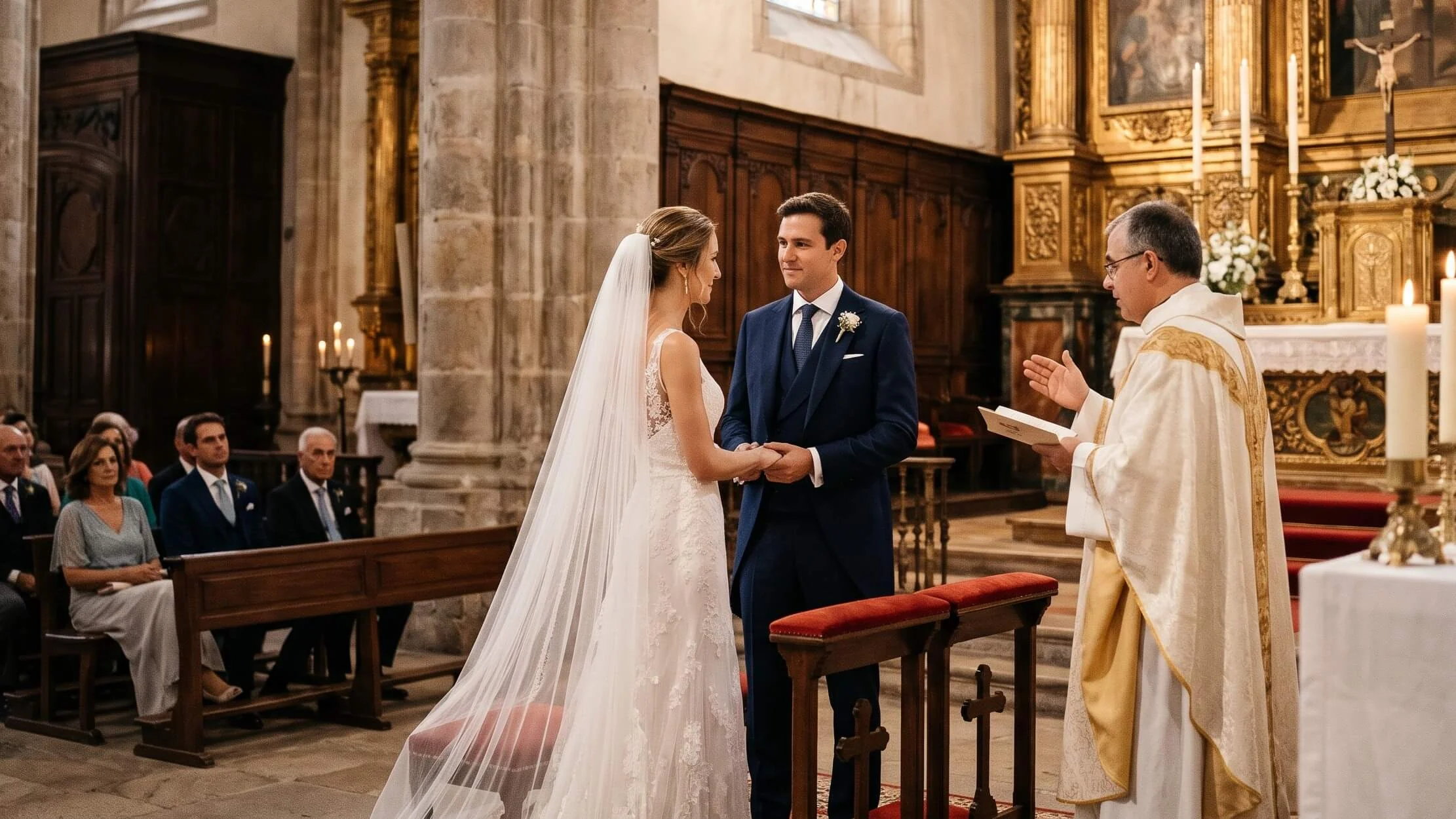
Religious marriage: Catholic ceremonies are open to non-residents with the bishop’s permission, but at least one of you must be Catholic. Start preparing about 6 months ahead, and ensure that after the marriage, the church reports your union to the Registro Civil to give it civil effect.
- 3
Symbolic ceremony: Your symbolic ceremony lets you exchange vows anywhere you choose, although it has no legal effect. No residency requirement applies for symbolic ceremonies. - 4
Marrying legally in the UK first: In this case, you give notice at your local register office and marry in the UK before you celebrate in Spain, which removes the Spain residency rule. If you later relocate to Spain, your Spanish registry will usually ask for an apostille and a sworn Spanish translation of your UK marriage certificate.
Documents needed to get married in Spain
To marry in Spain from the UK, you must have the core documents, such as each partner’s certificate of no impediment and full birth certificate. Your area’s registry might request additional documents. You can check this by asking for its full list early.
Here are the 4 core documents you need to marry in Spain:
1. Certificate of no impediment
Spain asks UK nationals for a certificate of no impediment, the most common UK form of the single status certificate we mentioned earlier, which confirms you’re free to marry.
You apply for the certificate in person at a UK register office, which requires a 28-day notice period before issuing it.
If you can’t obtain a CNI, you can use a statutory declaration of single status instead, provided your registry accepts one.
You can order an apostille for the statutory declaration once a solicitor or notary registered with the Foreign, Commonwealth & Development Office (FCDO) has witnessed it.
2. Birth certificates and valid passports
You both need an original full birth certificate, which is the long version that lists your parents’ names.
If your birth was registered in Wales or England, you can order a certified copy from the General Register Office or from the local register office where it was registered.
You also need a valid passport, valid for at least 12 months after you apply (for some registries).
3. Decree absolute or death certificate
If you were married before, you need proof the marriage ended, such as a decree absolute or your late spouse’s death certificate, which your registry uses to confirm you’re free to marry again.
In England and Wales, a final order replaces the decree absolute for divorce applications made from 6 April 2022.
You can ask the court that granted your divorce for a certified copy of either document.
4. Padrón and proof of residence
If one of you already lives in Spain, the resident partner provides a padrón certificate, an official record from the local town hall showing the partner’s registered home address.
The historical version also shows how long the partner has lived there, which helps the registry check the residency period.
Some registries want a recently issued copy, which you can confirm in your step 1 document list. If the registry asks, the partner must also provide a TIE.
Note: The good news is that Spanish documents don’t need a UK apostille.
How to get married in Spain from the UK in 5 steps
Here are the 5 steps for the documents and legal processes involved in marrying in Spain from the UK.
Quick note: Steps 3 and 4 happen in the UK, while steps 1 and 5 involve your Spanish registry. Your venue and travel plans are outside the steps and add to your overall timeline.
Apostille and sworn translation requirements for Spain
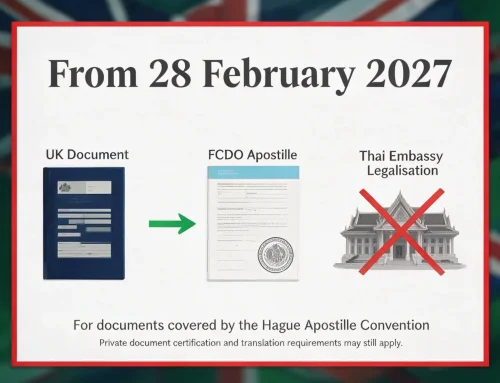
Spain is part of the Hague Apostille Convention, so your UK documents only need an apostille. You don’t need embassy legalisation.
Here’s what to keep in mind:
Which UK documents need an apostille?
Spanish registries usually want you to have the following UK documents apostilled:
When do you need a sworn Spanish translation?
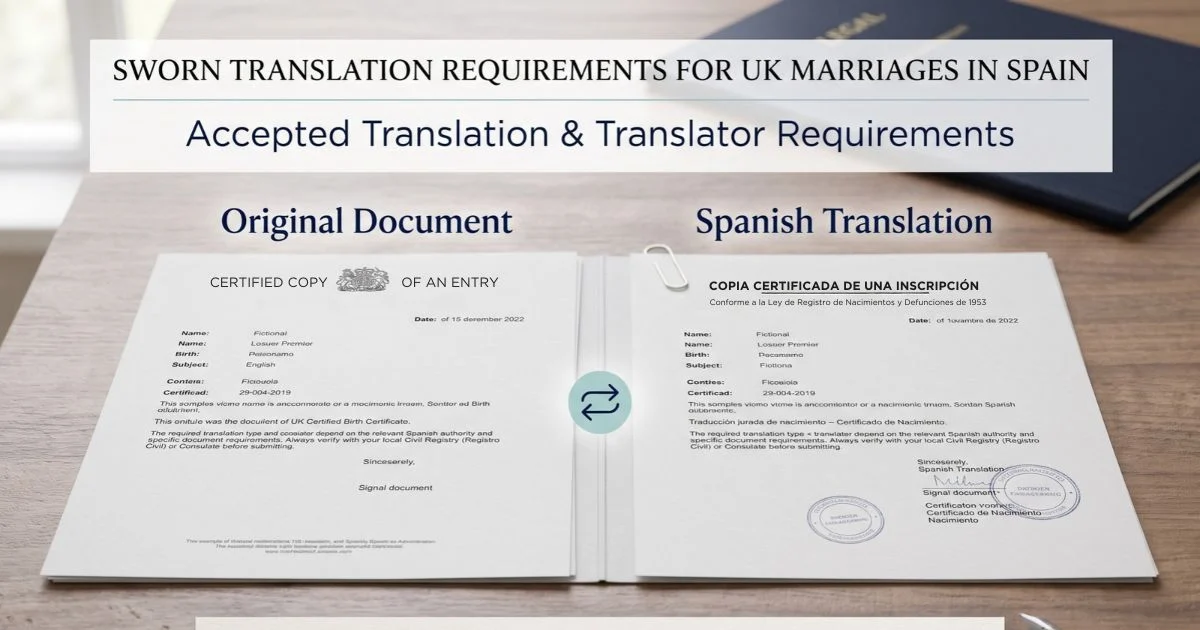
Every English-language document in your file needs a sworn Spanish translation.
You can have the translation done in Spain once your apostilled documents arrive.
You can also arrange it from the UK through a sworn translation service, but you must first confirm whether your registry accepts a translation done in the UK.
How London Apostille Services Ltd prepares your documents for Spain
Once your documents are ready, you’ll want a specialist to legalise them, which we do at London Apostille Services as an FCDO-registered business.
We help you get your UK documents apostilled for use abroad. If your documents need to be certified by a solicitor or notarised first, we can arrange that for you.
Here are 3 ways we support your Spanish marriage file:
Common paperwork mistakes that can delay your Spanish marriage
You’ll want to avoid the 3 mistakes below because small details can stall even a well-prepared file:
1. Documents the registry treats as out of date
An apostille never expires. The issue is the date of the document underneath it. Many registries only accept a certificate of no impediment or birth certificate issued within the last 3 to 6 months. If yours is older, the registry may reject it, even with a valid apostille.
Check the time limit for each document with your registry before you book the marriage. If a document is too old, you’ll need a newly issued copy, and that new copy will need its own apostille.
2. Missing or uncertified sworn translation
You might fail to submit a translation, or submit one that isn’t sworn.
Spanish registries treat sworn and certified translations as different documents and accept only sworn translations. If you need a document translated in Spain, the registries expect it to be from a traductor jurado, a translator appointed by Spain’s Ministry of Foreign Affairs.
3. Name mismatches across documents
The registry might reject or return your file if your name reads differently on your passport, birth certificate, or other critical documents.
For example, your middle name may be missing, or you may have changed your surname. Perhaps a part of your name is spelt incorrectly in some of the documents. The correction will depend on the type of mismatch.
If you’ve changed your name, you can prove the change with a marriage certificate or deed poll.
Frequently asked questions (FAQs)
Here are answers to the questions UK couples ask most about marrying in Spain:
Get your marriage documents ready for Spain
Your wedding in Spain begins with where you live. If one of you lives in Spain or has Spanish nationality, you can file for a civil marriage; if neither of you does, a Catholic ceremony or a UK wedding first works well.
The bottom line is that you must have the right documents, and they must be legalised according to the Spanish registry’s requirements. You’ll need your CNI, birth certificates, and an apostille and translation for each document. You also have to file with the Registro Civil.
Getting all your documents in order takes time and effort, which is where a document legalisation service comes in handy.
At London Apostille Services Ltd, we have legalised UK documents for use abroad for over 15 years as a business that’s registered with the FCDO.
Through our network of FCDO-registered solicitors and notaries, we can arrange certified copies and witnessed statutory declarations before your apostille, which keeps your whole file in one place. We review your documents before submitting them to the FCDO for apostilling.
We also email you a free scan of each apostille and return your originals via tracked, insured DHL Express, so you don’t have to worry about their safety.
Reach out to our team today to discuss your document legalisation needs for your marriage in Spain.