
You might be asked for a notarial certificate whenever you need to use a UK document in another country.
Foreign registries, courts, and universities have no way of checking whether a British degree certificate or a company document is genuine. So they might want a regulated UK professional to confirm it first.
Not every document needs one, though. Some go straight to the FCDO for an apostille. Others only need certification by an FCDO-registered solicitor.
Below you’ll find what a notarial certificate covers, when you actually need one, and the types you might come across.
What is a notarial certificate?
A notarial certificate is a short written statement that a notary public attaches to your document. The statement records what the notary did (witnessing your signature or verifying a copy), along with the date and place. It carries their signature and stamp.
Note that a notary never confirms that what your document says is true. They confirm only the facts they checked themselves, such as your identity against your passport, the date and place you signed, or that a copy matches the original in front of them.
In England and Wales, notaries are appointed and regulated by the Faculty Office of the Archbishop of Canterbury. Part of what a UK notary public does is act as an impartial witness, which is why authorities abroad trust them over other professionals.
When do you need a notarial certificate?
Whether you need a notarial certificate depends on the document, where it’s going, and what the receiving authority asks for.
Some require a FCDO-registered notary, while others accept certification from an FCDO-registered solicitor.
The situations that come up most often are:
Notarisation is only the first step for many of these documents. Many of them also need an apostille before they’re valid abroad.
What does a valid notarial certificate look like?
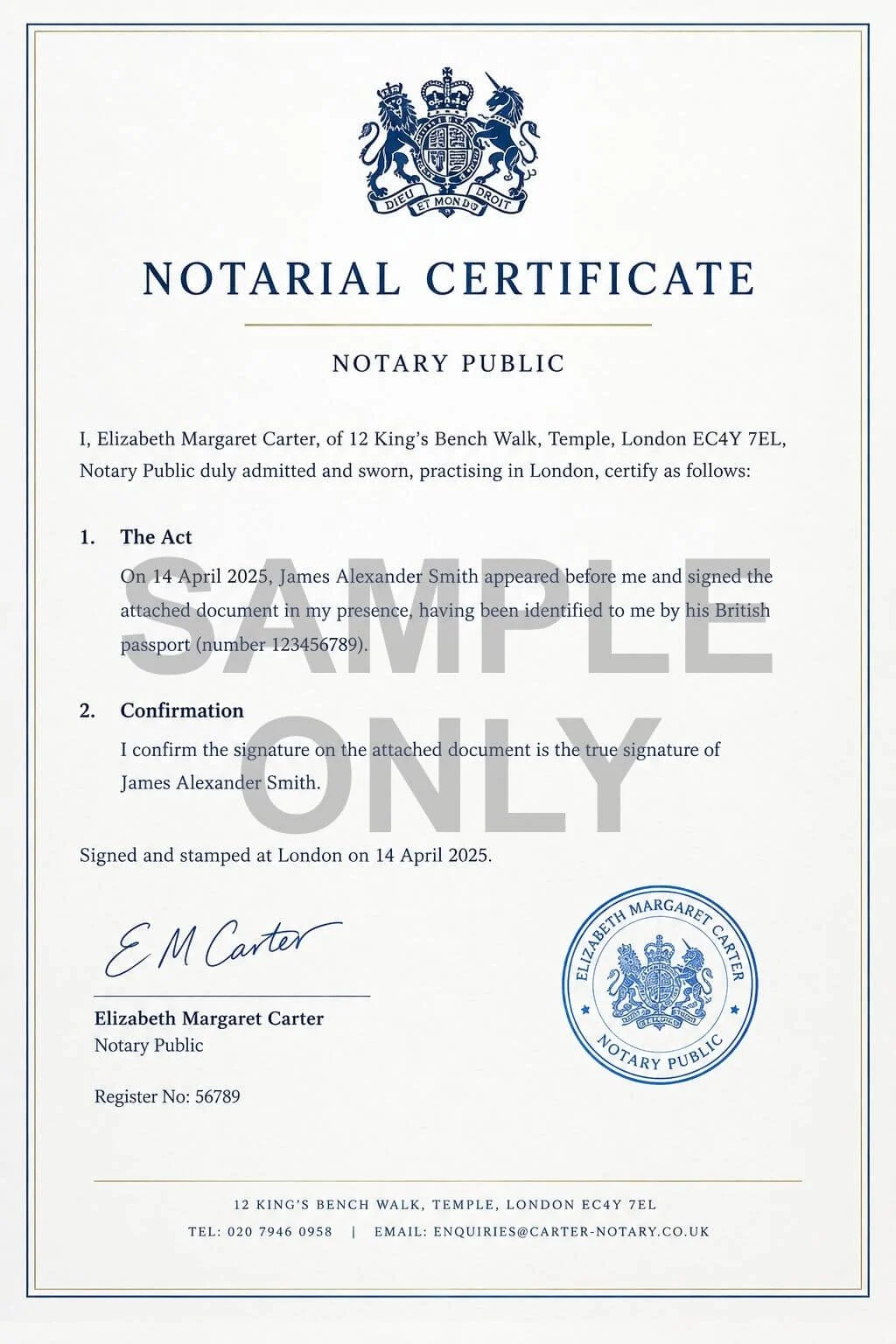
A valid certificate names the notary, describes what they did, and carries their signature and stamp. Anything missing from this list gives the receiving office grounds to refuse it.
Check that yours includes all of the following:
Certificates also come in 2 forms:
A private form certificate is attached to the document you brought in. The notary signs and stamps their wording, then hands the document back to you. Most UK notarisation works this way.
A public form certificate is written by the notary from scratch on separate paper. They set out what happened in their own words, sign and stamp it, then keep a copy in their records. Countries across Europe and Latin America often ask for this.
Some notaries now sign certificates digitally rather than by hand. The rules on remote notarisation in the UK allow this in certain situations, such as:
The office receiving your document still decides whether a digital certificate is acceptable, so check before you book that kind of appointment.
Notarial certificate format and example
England and Wales has no single statutory template for this wording. Notaries follow established form and adjust it to suit the destination country.
A certificate for a witnessed signature has 4 parts:
For a certified copy, the ‘act’ section changes. The notary states that they examined the original document and that the attached copy matches it.
Types of notarial act and what each certificate says
Four notarial acts cover most overseas document work. Which one applies to you depends on what the receiving authority needs confirmed.
Below is what each act involves and what its certificate confirms:
1. Certifying a copy of a document
A certified copy lets you send a copy abroad while your original stays with you. The notary compares the 2 documents in front of you, then certifies that the copy matches.
Where your document only exists as a PDF, such as an online bank statement, you can log into the account during the appointment so the notary sees the source.
Civil partnership certificates work differently. You must always send the original for an apostille, since a photocopy won’t be accepted. Notarial certification isn’t required for original documents.
2. Witnessing a signature
Notaries witness signatures on powers of attorney, contracts, and deeds. The certificate records who signed, the date they signed, and confirms the notary checked their identity beforehand.
You bring photo ID, the notary checks it, then you sign the document in front of them. Signing beforehand defeats the purpose, so leave the signature blank until the appointment.
Signing for a company adds a step. The notary also needs proof that you can bind it, such as a board resolution or a company search.
3. Administering an oath or affirmation
Affidavits and statutory declarations require you to swear or affirm in front of the notary that the contents are true.
An oath uses religious wording, while an affirmation is the non-religious version. Both carry the same legal weight. Statutory declarations close with wording from the Statutory Declarations Act 1835, confirming you believe what you’ve said is true.
Book a physical appointment for these. Remote appearance is possible in some cases, though the law behind a particular document can still require you to be physically with the notary when you swear it.
The authority receiving your document also has to accept a remotely sworn declaration, so check both points before you book.
4. Notarising a translation
If your document is going to a country that doesn’t use English, a sworn translator produces the translation and signs a declaration about its accuracy. The notary then verifies the translator’s identity and signature.
Note: The notary isn’t vouching for the translation itself. That responsibility sits with the sworn translator who signed the declaration.

Pre-notarisation checklist: How to avoid refusal
Your document can be refused at 3 stages. The notary might turn you away on the day, or the FCDO might reject it before issuing the apostille. The office abroad can also send it back after that.
Many of these refusals come down to something you could have checked beforehand.
Work through the list below in order to get a document notarised in the UK:
When a notarial certificate needs an apostille
The destination country decides whether your notarial certificate needs an apostille. Documents going to Commonwealth countries, and to many parts of the United States, seldom need legalisation at all.
Where legalisation is required, the apostille lets a foreign office rely on your notary’s signature and stamp, because that office holds no record of British notaries.
People often confuse notarisation and an apostille, though the two do different jobs. Notarisation covers your document. The notary checks your identity, your signature, or your copy, then certifies what they found.
An apostille covers the notary. Only the FCDO can issue one. Its Legalisation Office checks the signature and stamp on your certificate against its own records. The apostille goes on once the office confirms your notary is on its register.
Not every document needs notarisation first, though. Originals already signed by a British public official can go straight to the FCDO, such as a birth certificate from the General Register Office.
Photocopies, degree certificates, powers of attorney, and company documents are the ones that need a notary or solicitor before the apostille stage.
You might also need embassy attestation on top of these two steps, depending on your destination country.
| Destination | Steps after notarisation | Examples |
|---|---|---|
| Hague Convention country | FCDO apostille only. | Spain, France, China. |
| Non-Hague country | FCDO apostille, then attestation at that country’s embassy in London. | Qatar, Egypt, Kuwait. |
127+ countries belong to the Hague Apostille Convention. For those, the apostille completes the legalisation route. However, new members join the Hague Convention every year, so check your destination country’s current status before you plan the route.
London Apostille Services Ltd handles the UK side of that chain for you. Once your notarial certificate is in place, we submit the document to the FCDO and chase it through. If the destination country needs embassy attestation, we can arrange that too.
A digital e-apostille is available as well. For that route, your document needs an electronic signature from the notary or solicitor.
Working out which service is needed is where most people get stuck. Tell us the destination country and your deadline when you book online, and we’ll put it on the right route.
Frequently asked questions (FAQs)
Below are the questions we hear most from people arranging a notarial certificate for the first time:
Route your notarisation through us
London Apostille Services Ltd arranges notarisation, apostilles, and embassy attestation for anyone sending UK documents overseas. We work with a network of FCDO-registered solicitors and notaries, then handle the FCDO submission ourselves.
The business is registered with the FCDO Legalisation Office and named on the UK government’s list of next-day legalisation providers. That listing gives us the next-day submission route, which the FCDO doesn’t open to people applying directly. They wait on the standard postal service instead.
We have 35 years of collective experience in this trade, during which we have processed more than 70,000 documents.
Start by telling us where your document is going and when you need it back. From there, you can place your order online and get the certificate, the apostille, and any embassy stage handled in one go.