
If you need to use a UK document abroad, a sworn translation vs a certified translation is one of the first choices you have to get right. If you pick the wrong one, your paperwork can be rejected at a consulate, a university, or a foreign registry office.
The confusing part is that the two are not simply better or worse versions of each other. They belong to different legal systems, and the UK only produces one of them.
Below, we explain both terms, show you which countries require which, and cover the extra steps (notarisation and apostille) that may be added on top. By the end, you should know exactly which type of translation to ask for.
TL;DR – Sworn translation vs certified translation
Here are the fast facts before we get into the details:
What is a certified translation?
A certified translation is a translation accompanied by a signed declaration confirming its accuracy and completeness.
That declaration is usually called a certificate of accuracy, and it names the translator or company, gives their contact details and credentials, and carries a date and signature or stamp. The wording confirms it is a true and accurate translation of the original document.
The UK translation industry is not regulated by the government, so there is no single licence a translator must hold. In practice, UK authorities want the work done by a translator or company linked to a recognised professional body.
You will need a certified translation for things like:
For UK visas, the Home Office asks for a full translation that its officers can independently verify, and it does not require you to have that translation notarised or signed off by a solicitor. A standard certified translation is enough.
This is the same standard; the difference between apostille and legalisation often sits alongside, since documents heading overseas can need both a translation and further authentication.
What is a sworn translation?
A sworn translation is produced by a translator who has been formally authorised by a court or government to certify translations in their country.
Once that translator signs and stamps the document, the translation is accepted by authorities as officially valid on its own, without further certification.
The translator’s authority comes directly from the state, which is what separates a sworn translation from a certified one. A sworn translator is only “sworn” in the country that appointed them.
How someone becomes sworn depends on where they are:
You will also find sworn systems in Belgium, Austria, Portugal, the Netherlands, the Czech Republic, Romania, Hungary, Greece, and across Latin America, including Brazil, Argentina, and Mexico.
The UK does not have any of this, and that gap is the root of most confusion. We explain why in the comparison below.
Sworn translation vs certified translation: The key differences
The core difference is legal recognition. A sworn and a certified translator can produce equally accurate work. What changes is who backs the document and where it is accepted.
| Factor | Certified translation (UK) | Sworn translation (civil-law countries) |
|---|---|---|
| Legal status | Professional statement of accuracy | Legally equal to the original document |
| Who produces it | Any qualified translator or company (ITI, CIOL, or ATC preferred) | Only a court- or government-appointed sworn translator |
| Source of authority | The translator’s credentials and signed declaration | A state or court appointment plus an official stamp |
| Where it’s accepted | UK, US, and most English-speaking countries | Spain, France, Germany, Italy, Poland, and similar |
| Typical cost | Lower, from around £25 to £35 per page | Higher, because of the official status and oath step |
| Turnaround | Fast, often the same or the next day | Often slower, as a court or oath step is involved |
The reason for the split comes down to legal tradition. The UK uses common law, which relies on qualified professionals certifying their own work.
Most of continental Europe and Latin America use civil law, which relies on officials who have been sworn in by the state. Neither is superior. They just recognise documents in different ways.
CIOL, one of the UK’s main linguist bodies, has said plainly that no sworn or state-authorised translation system exists in the UK, and that this is unlikely to change.
So when a UK provider offers a sworn translation, they arrange it through a translator registered in the destination country, or add the notarisation and apostille steps covered further down.
Get your translation handled by London Apostille Services Ltd.
At London Apostille Services Ltd, we cover all of these steps under one roof. You can get certified, sworn, notarised, and legalised translations from £50 per page, with expert translators, notarial services, and optional FCDO legalisation handled as one process.
That keeps things simple and helps you avoid the errors that come from piecing the steps together yourself.
We provide:
We also handle business and legal document translations that don’t need an apostille or legalisation at all.
We have worked with over 3,000 translators and completed thousands of certified, sworn, notarised, and legalised translations for customers around the world, with 99.9% accuracy regardless of project size.
If you would like a quote for your documents, you can enquire about a translation, and we will confirm which type you need.
Which countries require sworn translations?
As a rule of thumb, civil-law countries in Europe and Latin America expect sworn translations for official documents.
The list includes Spain, France, Germany, Italy, Poland, Portugal, Austria, Belgium, the Netherlands, the Czech Republic, Slovakia, Hungary, Romania, Greece, Luxembourg, Brazil, Argentina, Mexico, and more.
The requirement is often strict. Spanish consulates and immigration offices, for example, only accept a traducción jurada from a sworn translator appointed by MAEC.
A certified translation from the UK or the US will not, on its own, meet the standard. The same applies in Italy, where a plain certified translation has no legal value for public bodies, so an asseverazione is needed instead.
Common documents that trigger a sworn requirement include:
Because rules vary by country, consulate, and even the specific office handling your case, treat any list as a starting point rather than the final word. Confirm the requirement with the authority asking for your document.
When a certified translation is enough
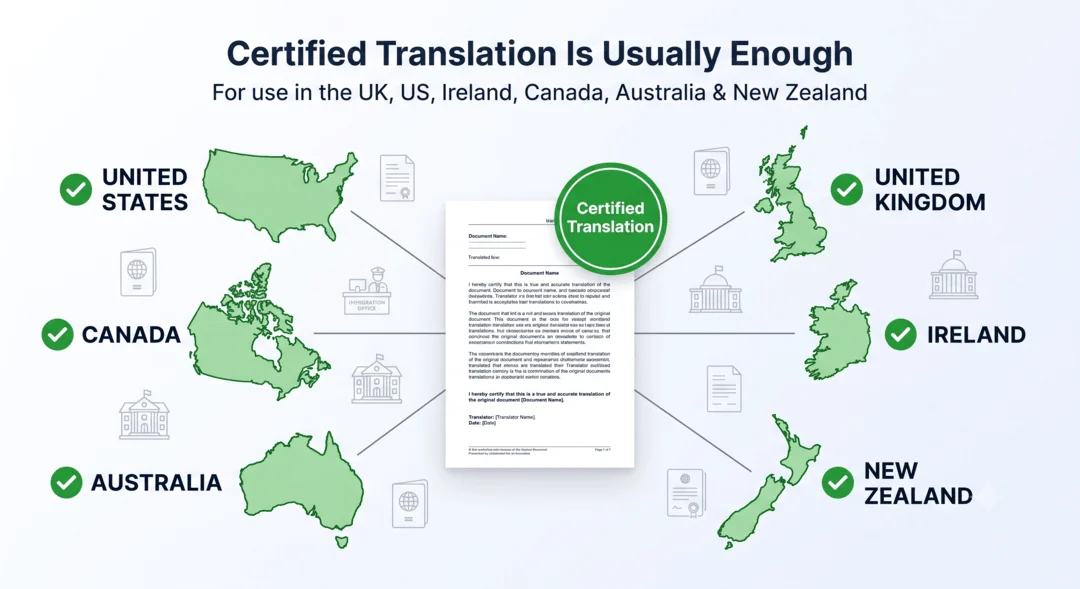
For most English-speaking and common-law jurisdictions, a certified translation will suffice.
Here is where it typically holds up:
If your document is staying within the UK or heading to a country like the US, Ireland, Australia, Canada, or New Zealand, a certified translation is usually all you need. Trouble tends to start only when the document is bound for a civil-law country that expects a sworn version.
You can read more about how to certify documents in the UK if you are not sure what “certified” covers.
Why an apostille or notarisation may be added to your certified translation
Sometimes a certified translation is only the first step. A foreign authority may request additional proof that the document is genuine. And that is where notarisation and an apostille come in.
Because the UK has no sworn register, these two steps are how a UK translation gains legal standing abroad.
Here is the usual order:
- 1
Translation: A qualified translator produces the certified translation.
- 2
Notarisation: The translator signs a declaration in front of an FCDO-registered UK notary public. The notary confirms the translator’s identity and that the signature is genuine. A notary does not check the translation itself for accuracy, only that the professional who signed it is real.
- 3
Apostille: The notarised document goes to the Foreign, Commonwealth and Development Office (FCDO), which attaches an apostille verifying the notary’s signature. For countries outside the Hague Convention, such as Qatar, Egypt, or Kuwait, embassy attestation is used instead.
If your document needs both translation and legalisation, our guide to translation options for apostille legalisation explains how the two fit together.
How sworn translations are delivered – and when a consulate gets involved
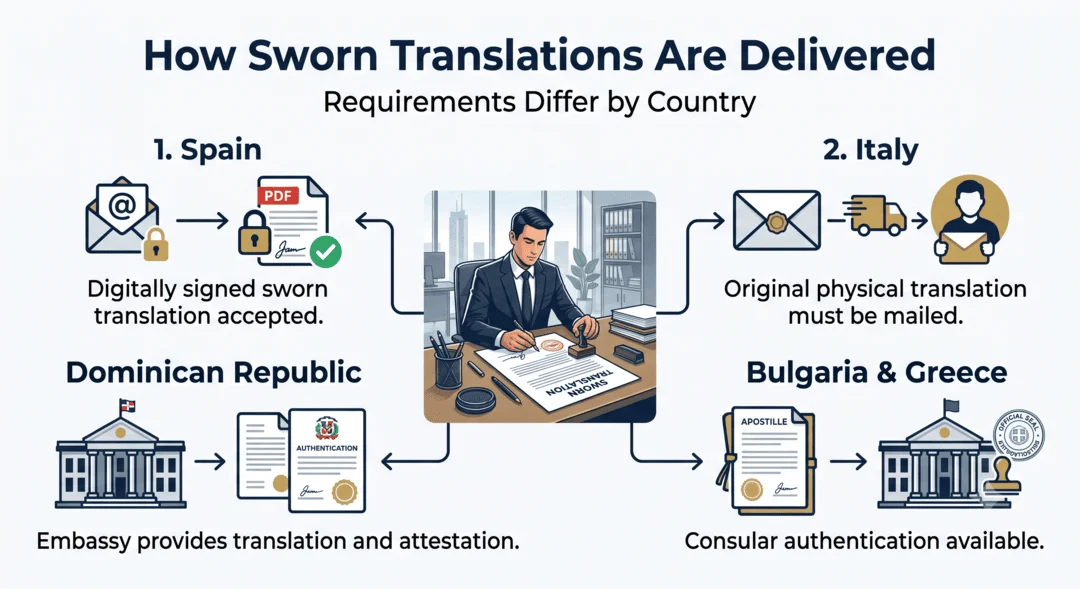
Sworn translations are usually completed by a translator in the destination country, then emailed or posted back to you, depending on that country’s requirements.
Spain accepts digitally sworn translations, so a signed and stamped electronic copy is often all you need.
Italy is stricter: the physical translation must always be posted to the customer.
Some countries offer a consular step. For example, Bulgarian and Greek sworn translations can be authenticated by the relevant embassy or consulate here in the UK. The translator binds the apostilled document and their translation together, then presents the bundle to the consulate for authentication.
A few embassies go further still – the Dominican Republic offers both the translation and the embassy attestation directly through its own service.
Frequently asked questions (FAQs)
Below are quick answers to the questions we hear most often about sworn and certified translations.
How London Apostille Services Ltd can help
Working out which translation you need is half the battle. Getting it done correctly and legalised is the other half.
At London Apostille Services Ltd, we handle certified and sworn translations in over 130 languages, as well as notarisation, solicitor certification, and FCDO apostilles.
If your document is heading to a civil-law country that requires a sworn translation, or to a Hague Convention country that needs an apostille on top, we manage the full process so nothing gets bounced back. You can explore our apostille translation services to get started.
If you would like a price for your specific documents, request a quote, and we will point you to the right option.