A statutory declaration, often shortened to “stat dec”, is a written statement you formally declare to be true in front of an authorised person.
Say you are marrying in Spain and the registrar asks for proof that you are not already married to someone else. You would make a statutory declaration confirming your single status, then sign it in front of a solicitor or notary.
The same process applies to name changes, lost documents and company paperwork.
But who can witness a statutory declaration? We will answer that below, along with who cannot witness one and what your witness actually does.
Signing vs. witnessing a statutory declaration
Two people sign a statutory declaration:
Both signatures must appear on the page, or the declaration is not valid.
Your witness has a narrow role in all this. They check your identity, then confirm you signed the document properly in front of them. Whether the contents are true remains your responsibility alone.
Making a false statutory declaration is a criminal offence under section 5 of the Perjury Act 1911, punishable by up to 2 years in prison.
Who can witness a statutory declaration in the UK?
Witnessing a statutory declaration counts as administering an oath, which the Legal Services Act 2007 classifies as a reserved legal activity.
It means only certain regulated professionals are legally allowed to do it. That sets it apart from the rules on who can witness a signature on a legal document, which any independent adult can usually do.
Here is who qualifies in England and Wales, along with what to check before you book:
| Who can witness | What to check first |
|---|---|
| Practising solicitor | A current practising certificate. Every solicitor who holds one is automatically a commissioner for oaths. |
| Notary public | A current practising certificate. This is your best choice if the document is going overseas. |
| Commissioner for oaths | That the title is current and the person is still practising. |
| Chartered Legal Executive (CILEX Fellow) | A valid practising certificate and up-to-date CPD. Grades below Fellow are not authorised. |
| Licensed conveyancer | Authorised under the Commissioners for Oaths (Prescribed Bodies) Regulations 1994. |
| Justice of the Peace or magistrate | Availability, since appointments are limited. |
| Court officer authorised to administer oaths | Ring the court office beforehand. |
| British consular officer, if you are abroad | Whether the service is available, because it is not on offer in Commonwealth countries. |
Barristers also hold the power under section 113 of the Courts and Legal Services Act 1990. So do officers in the armed forces at the rank of Major, Lieutenant-Commander, or Squadron Leader and above, when the person declaring is service personnel.
There are not many notaries in the UK. The Notaries Society puts the number practising in England and Wales at roughly 775, so appointments often need booking a few days ahead.
The rules change across the UK
However, the position is not the same in every part of the UK, so check where your witness is based:
Who cannot witness a statutory declaration?
Independence is the test here, so anyone close to you or close to the subject matter is ruled out.
Two separate things can disqualify a witness. The first is a lack of qualification. The second is a lack of independence.
Anyone missing from the authorised list above cannot witness your declaration, whatever their relationship to you. That rules out a friend, a neighbour, or a relative who does not hold one of those qualifications.
Someone who is qualified can still be ruled out if they have an interest in the matter.
In practice, that means avoiding:
You cannot witness your own declaration either.
The same restriction on interest applies to Chartered Legal Executives who act for a party in the matter.
Even where a relative happens to be qualified, many receiving bodies refuse a declaration witnessed by a family member, so an unconnected professional is the safer choice.
Some organisations add restrictions of their own. Staff at HM Passport Office, for example, cannot witness a statutory declaration at all.
What happens if the wrong person witnesses it
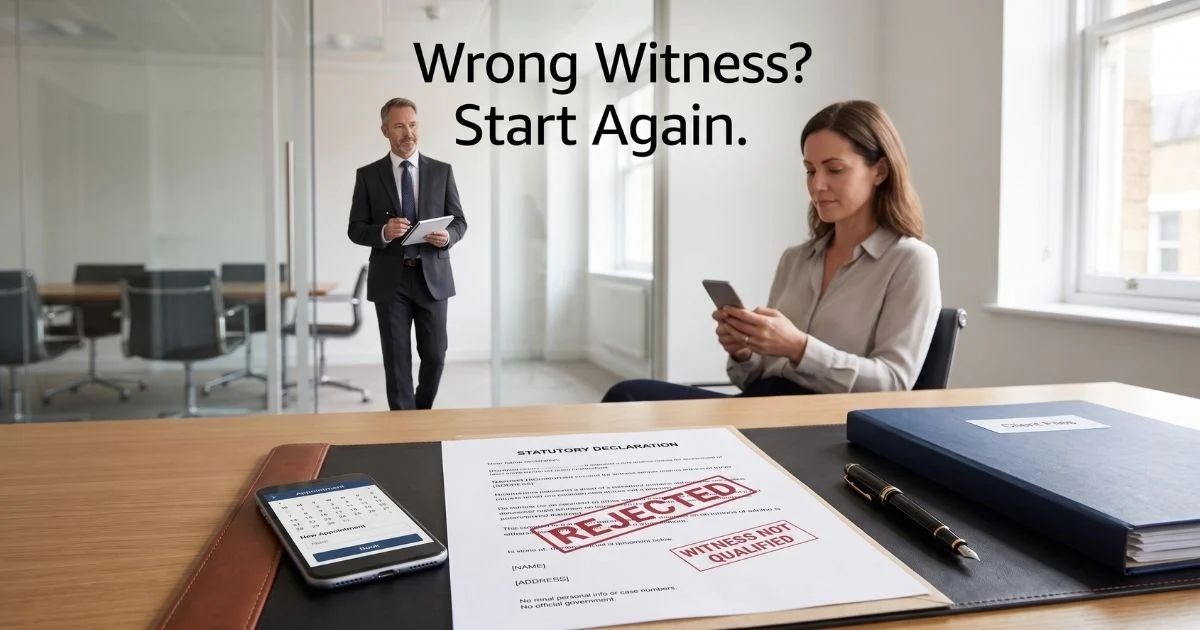
Your document gets refused. Banks, lenders, HM Land Registry, courts, and embassies all check who witnessed a declaration before they accept it.
You then book a fresh appointment with a qualified witness and start again.
Choosing a solicitor or notary for overseas use
Where your declaration ends up decides which professional you need.
For a document staying in the UK, a solicitor or commissioner for oaths is normally enough. The fee is fixed by law at £5 for the declaration plus £2 for each exhibit, under the Commissioners for Oaths (Fees) Order 1993.
For a document going abroad, a notary public is the safer choice. Notaries are the branch of the UK legal profession that deals with documents used overseas, and they are regulated by the Faculty Office of the Archbishop of Canterbury.
Foreign authorities also recognise a notary’s signature far more readily than a solicitor’s. So if your instructions say the document must be “notarised”, book a notary.
Here is how the two compare on cost and where each one fits:
| Solicitor or commissioner for oaths | Notary public | |
|---|---|---|
| Typical fee | £5 plus £2 per exhibit, set by law | Set by the notary, since notarial fees are not fixed by law |
| Best suited to | Documents used inside the UK | Documents used overseas |
| Recognition abroad | Sometimes questioned or refused | Widely accepted |
One more check matters when your declaration is going abroad. The FCDO can only issue an apostille if it already holds a sample of your witness’s signature, so the witness has to be FCDO-registered.
A solicitor can be fully qualified and still not registered. No public list exists for you to check either. Ask the firm directly before you book. Our notary public service uses FCDO-registered professionals for exactly this reason.
How a statutory declaration must be witnessed
Most of the work happens before you sit down with your witness. The appointment itself usually takes around 20 minutes.
Here is how the process runs from start to finish:
- 1
Draft the declaration: Write your statement in plain, factual terms and include the wording required by the Statutory Declarations Act 1835. Attach any supporting documents as exhibits.
- 2
Book an appointment with an authorised professional: Choose a solicitor, notary public, or commissioner for oaths who has no connection to your matter. If the declaration is going abroad, confirm they are FCDO-registered before you book.
- 3
Bring the document unsigned: Your witness must watch you sign it, so a page you signed at home will be rejected.
- 4
Bring photo ID and proof of address: A passport or driving licence works for identity. For your address, a UK notary will accept any valid document showing your current address, whether it was issued in the UK or overseas.
- 5
Read the declaration with your witness: They will confirm you understand what you are declaring before anyone signs.
- 6
Sign in their presence: Video calls do not count for this step.
- 7
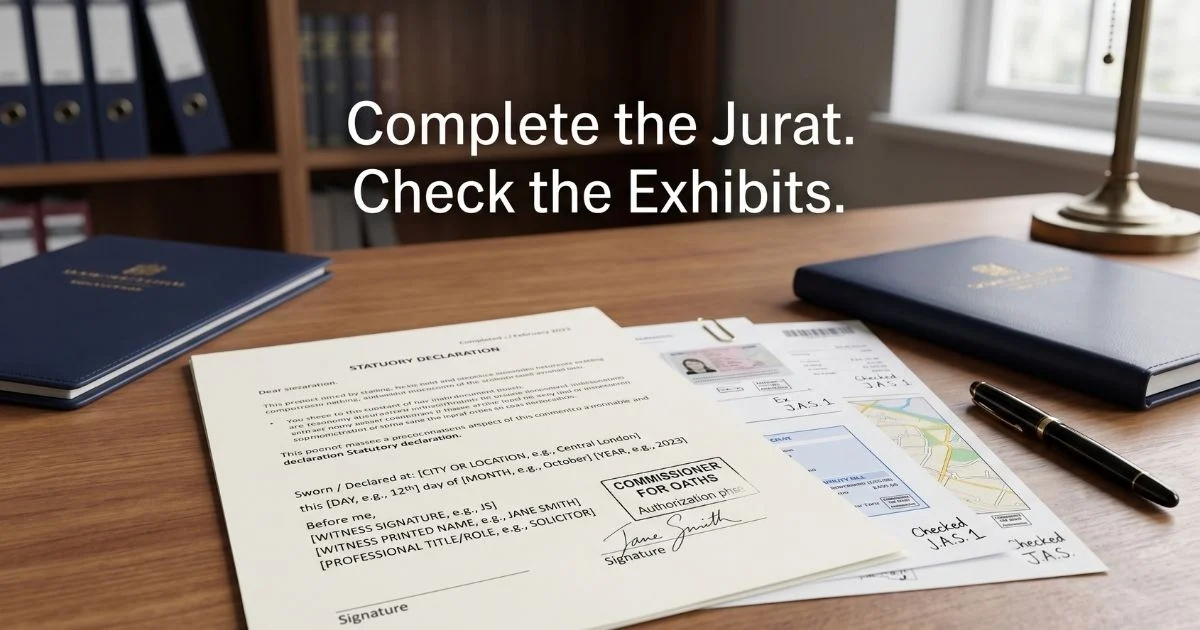
Let the witness complete the jurat: The jurat is the block at the bottom of the page, where they add the place, the date, their name, their professional role, their address and their stamp.
- 8
Check the exhibits before you leave: Every supporting document attached to the declaration must be marked and initialled by the witness.
The wording mentioned in step 1 comes from the Statutory Declarations Act 1835. The standard form runs like this:
“I, [full name], of [address], do solemnly and sincerely declare that [your statement]. And I make this solemn declaration conscientiously believing the same to be true, and by virtue of the provisions of the Statutory Declarations Act 1835.”
The jurat underneath follows a set pattern too:
“Declared at [place] on [date], before me,[Name],
Solicitor / Notary Public / Commissioner for Oaths.”
Mistakes that get declarations rejected
Rejections come down to a handful of avoidable errors:
How London Apostille Services can help you
At London Apostille Services Ltd, we can arrange the witnessing and the legalisation together.
We work with a network of FCDO-registered solicitors and notaries across the UK. That matters because the FCDO will only issue an apostille if it already holds a specimen of your witness’s signature on file.
Booking through us removes the guesswork about whether your witness qualifies.
Here is what we can arrange for a statutory declaration:
Our express service has a 9:30 am cut-off, so send your instructions the day before if you are working to a tight deadline. We have run this service for over 15 years. If a document is rejected because of something we got wrong, you get a full refund.
Our office is open 8 am to 5 pm Monday to Friday, with online support until 7 pm.
Let us take care of the paperwork while you focus on the move, the wedding, or the job offer. Submit your document today.
Frequently asked questions (FAQs)
Below are a few questions we hear most often about witnessing statutory declarations: