
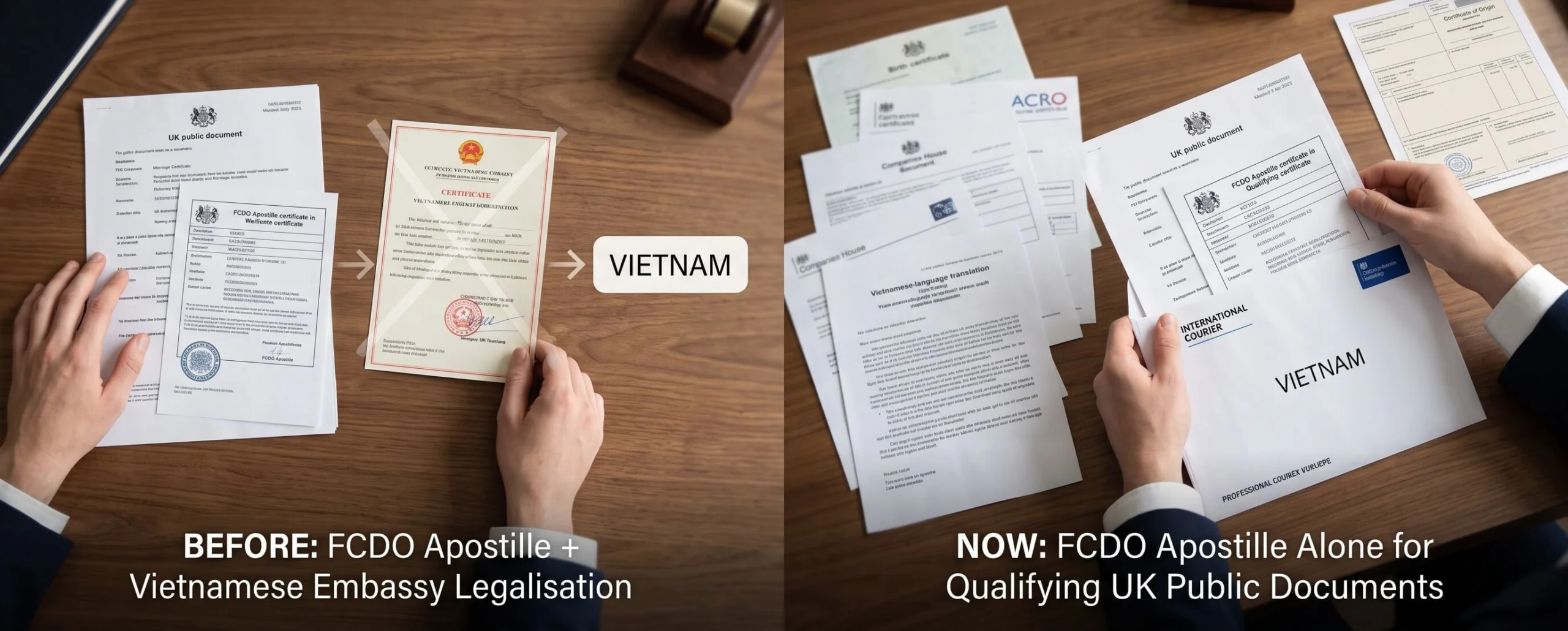
From 11 September 2026, UK documents bound for Vietnam need only an FCDO apostille. The Vietnamese Embassy legalisation step is no longer required.
Vietnam acceded to the Hague Apostille Convention on 31 December 2025. The Convention entered into force for Vietnam on 11 September 2026, together with Decree 293/2026/ND-CP, the domestic law that implements it.
Before that date, a UK document needed an FCDO apostille and then a second stamp from the Vietnamese Embassy in London. Now the apostille alone is enough.
This guide covers what changed, which UK documents are affected, what happens to documents already processed under the old system, and how London Apostille Services Ltd handles Vietnam-bound documents under the new rules.
The Apostille Convention and why Vietnam’s entry matters
The Hague Apostille Convention replaces multi-step consular legalisation with a single certificate. That certificate is the apostille. The issuing country issues it, and every other member country must accept it.
With Vietnam’s accession, the Convention has 129 Contracting Parties. Vietnam now appears on our Hague Convention countries list.
For UK senders, the practical effect is simple. Before 11 September 2026, a degree certificate for a Vietnamese work permit went to a solicitor, then the FCDO, then the Vietnamese Embassy in London. Each stage added fees, courier legs and waiting time, and the embassy stage was the slowest of the three. That final stage no longer exists.
Vietnam now sits alongside the other member countries the UK deals with most often. If you have apostilled a document for Spain, Italy or Australia, the process for Vietnam is now the same.
Timeline of Vietnam’s accession to the Hague Apostille Convention
The Hague Conference on Private International Law (HCCH) administers the Convention. Here is Vietnam’s path from accession to the first working day under the new rules.
| Milestone | Date |
|---|---|
| Vietnam deposits its instrument of accession | 31 December 2025 |
| HCCH announces the accession | 14 January 2026 |
| Decree 293/2026/ND-CP issued | 23 July 2026 |
| Convention enters into force for Vietnam | Friday 11 September 2026 |
| First working day with no embassy legalisation | Monday 14 September 2026 |
Decree 293/2026/ND-CP is Vietnam’s implementing law. It took effect on the same day as the Convention. It names the Ministry of Foreign Affairs as the authority that issues Vietnamese apostilles and sets out how Vietnam accepts apostilles issued abroad. It also confirms that documents legalised the old way before 11 September remain valid.
One practical note. The Vietnamese Embassy in London was still attesting UK documents on Friday 11 September. Monday 14 September was the first working day on which no embassy stamp was needed. Documents stamped on the 11th are valid either way.
What changes for UK documents bound for Vietnam?
Before 11 September 2026: a UK document needed an FCDO apostille, then a legalisation stamp from the Vietnamese Embassy in London. Only then would a Vietnamese authority accept it.
From 11 September 2026: the FCDO apostille alone is enough. The embassy step is gone for every UK public document within the Convention’s scope.
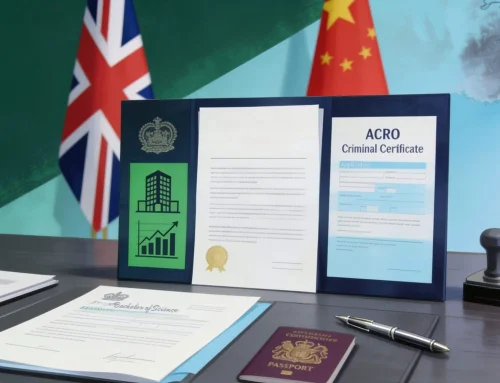
The Convention covers public documents. In UK terms, that means documents issued by a court, a government body, or Companies House; documents bearing the signature of a UK notary or FCDO-registered solicitor; and official certificates such as birth, marriage, and ACRO police certificates. If the FCDO can apostille it, Vietnam must now accept it.
Two categories sit outside the Convention. Administrative documents dealing directly with commercial or customs operations, such as certificates of origin, sit outside the Convention. If you’re sending trade documents to Vietnam, contact us first, and we’ll confirm the current route with the embassy.
Two things have not changed. An apostille confirms a signature, seal or stamp. It does not confirm the document’s content. And if your Vietnamese employer or authority wants a Vietnamese translation, they still want it. The apostille replaces the embassy stamp, not the translator.
Not sure whether your document falls under the Convention? Send us the details, and we’ll confirm before you commit.
UK documents that only require an apostille for Vietnam
The categories below cover the UK documents our Vietnam legalisation service handles most often. All of them now need only an FCDO apostille.
Personal documents
Birth, marriage and death certificates, ACRO police certificates, and certificates of no impediment for marriage in Vietnam. These already bear an official signature or seal. Most go straight to the FCDO with no certification step first.
Typical uses: marriage to a Vietnamese national, dependent visas, and the criminal record check for a work permit.
Academic documents
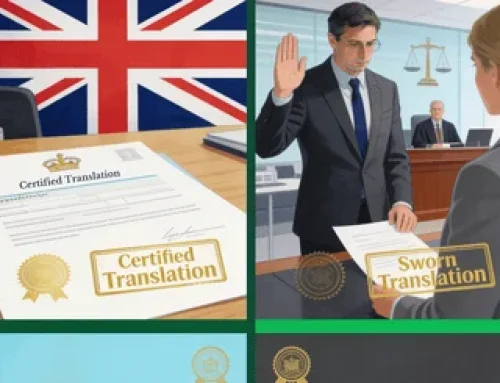
Degree certificates, diplomas, transcripts and TEFL certificates. Universities and awarding bodies are private institutions, so the FCDO cannot apostille their signatures directly. A UK solicitor or notary certifies the document first. The FCDO then apostilles the solicitor’s or notary’s signature.
Typical use: the qualification requirement for a Vietnamese work permit, which applies to almost every foreign employee, including English teachers.
Business documents
Companies House issues certificates of incorporation and certificates of good standing. Companies House also files memoranda and articles of association, and you can usually download a copy directly from the register.
We certify the downloaded copy before apostille, or order a certified copy from Companies House if the Vietnamese authority asks for one. Board resolutions, powers of attorney and audited accounts are signed privately and are not on the public record. A solicitor or notary certifies these first, then the FCDO apostilles the certification.
Typical uses include opening a representative office or subsidiary in Vietnam, appointing a local legal representative, and registering products with Vietnamese ministries.
The transition period and in-progress documents
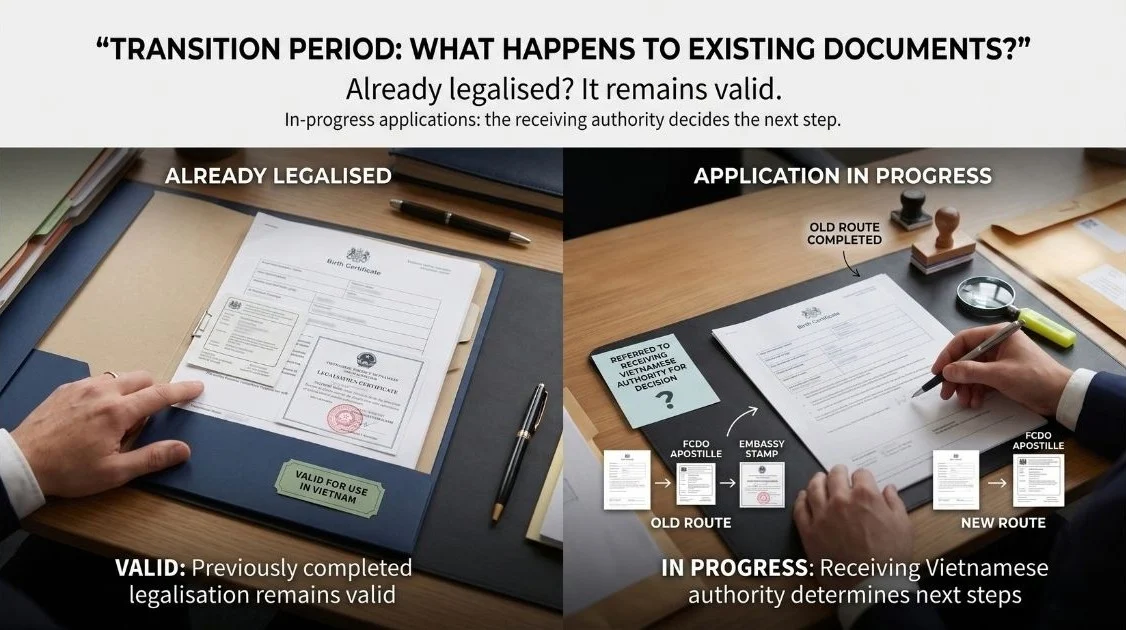
Vietnam’s entry into the Hague Convention doesn’t invalidate work already done under the old system. Here are 2 scenarios that cover most document holders:
Documents legalised before 11 September 2026
A UK document legalised by the Vietnamese Embassy before 11 September 2026 remains valid for use in Vietnam.
Decree 293 doesn’t require you to redo that work under the apostille route.
Applications already in progress
Was your document already mid-legalisation when the Convention kicked in? The receiving Vietnamese authority decides whether to accept it once the old process wraps up, or asks you for a fresh apostille instead.
Send us the receiving authority’s exact requirements, and we’ll confirm the right route for your document.
How to apostille a UK document for use in Vietnam
The route has four steps. Get the first one right, and the rest follow.
Need help apostilling UK documents for use in Vietnam?
At London Apostille Services Ltd, we are a duly registered document legalisation business. We coordinate certification, the FCDO apostille, and any Vietnam-specific requirements end to end.
Your order includes the following:
Want your Vietnam-bound documents handled correctly under the new rules?
Get a custom quote today for your academic, personal, or business documents.
Frequently asked questions (FAQs)
Here are answers to the questions UK document holders ask often about what Vietnam’s entry into the Hague Apostille Convention means for them:
Your next steps after Vietnam’s Hague Apostille Convention entry
The legalisation route for Vietnam-bound documents has changed for good. A single FCDO apostille now replaces Vietnamese consular legalisation for each qualifying UK document.
Personal and business documents generally go straight for apostille, while academic and other privately issued documents need solicitor or notary certification first, and documents already legalised under the old system remain valid.
At LAS Ltd, we’ve already handled Vietnam-bound degree and certificate legalisations for UK applicants seeking Vietnamese work permits. We’ll confirm exactly which of your documents qualify for the new apostille-only route before you commit to an order.
Reach out today to discuss your document timeline and which documents qualify for the new apostille-only route.