
Thailand deposited its instrument of accession to the Hague Apostille Convention on 30 June 2026. The Convention takes effect for Thailand on 28 February 2027.
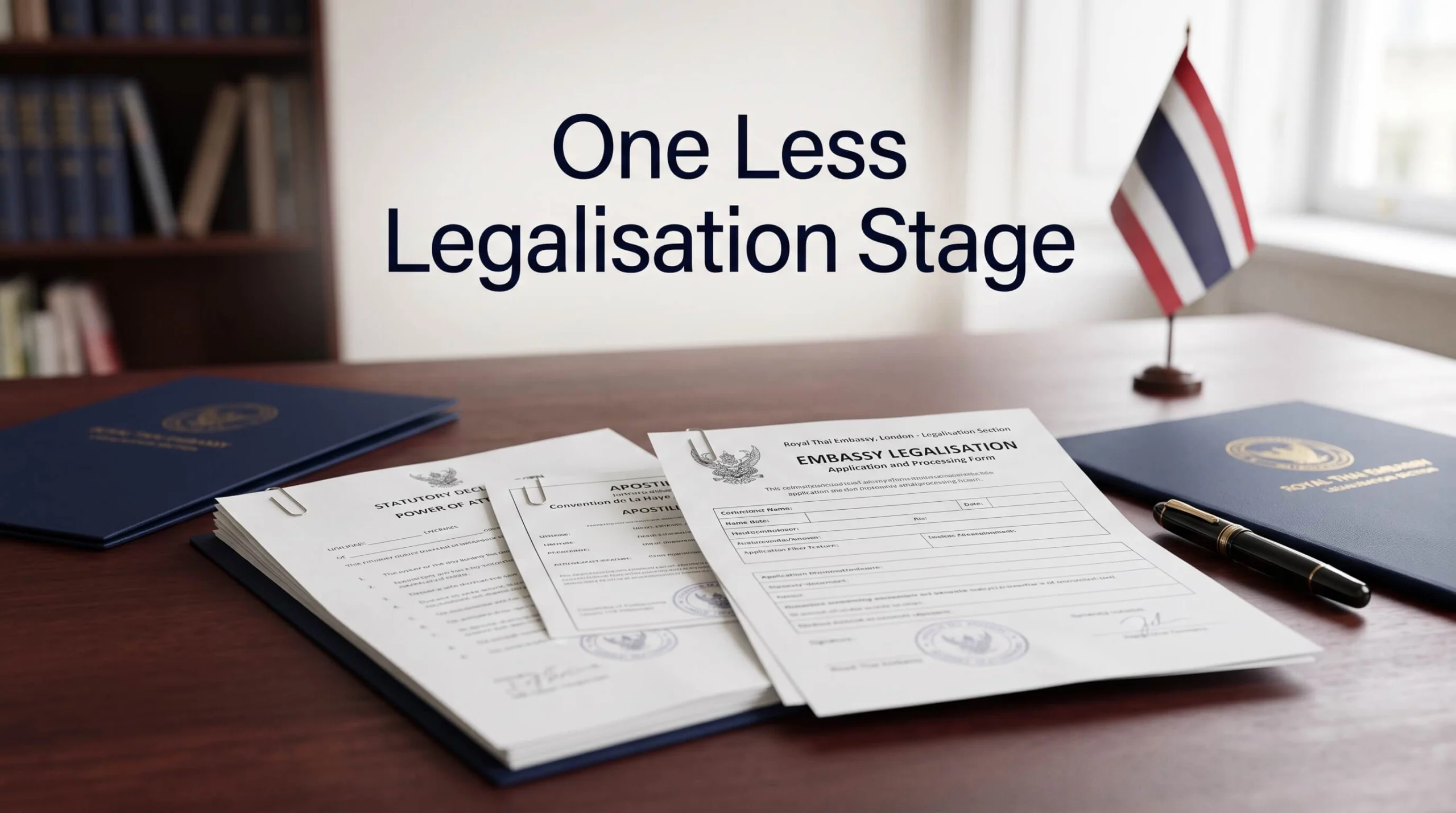
Until then, UK documents for Thailand must follow the existing consular legalisation route. From 28 February 2027, an apostille alone will be enough for documents the Convention covers, with no Thai Embassy legalisation needed.
The FCDO apostille is already the first stage of today’s route, so one stage is being removed, not replaced. Certification, translation and the receiving authority’s own rules stay the same.
What Thailand’s accession means for UK documents
From 28 February 2027, UK documents presented in Thailand will no longer need Thai Embassy legalisation. Two dates matter here:
Between these two dates, existing members have six months to object. That window closes on 30 December 2026, and the Convention takes effect 60 days later. An objection would stop the Convention from applying between Thailand and the objecting country. We’ll update this page once the window closes.
Here’s how the change affects the documents you send:
Why this matters for UK senders
Your UK apostille is already accepted across the Convention’s member countries. With Thailand’s accession, the Convention has 130 Contracting Parties, and Thailand joins them on 28 February 2027. Vietnam followed the same two-date path when it joined the Hague Apostille Convention. Its embassy attestation step ended on 11 September 2026.
How to legalise UK documents for Thailand before 28 February 2027
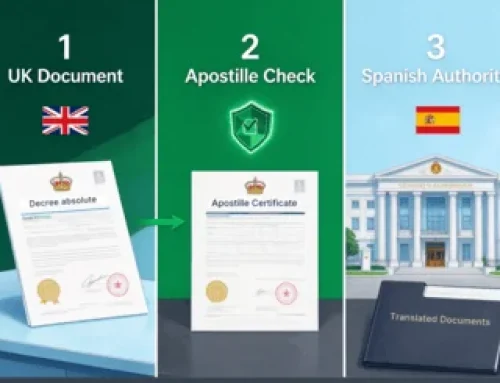
Until 28 February 2027, a UK document for Thailand needs an FCDO apostille and Thai Embassy legalisation in London. Many Thai authorities also ask for a Thai translation, which the Thai Embassy usually certifies in London at the same time. The full route runs in this order:
- 1
Check what the receiving authority wants. Ask the employer, university, district office or agency for its written requirements. These tell you whether it needs the original or a certified copy, and whether you need a translation.
- 2
Arrange certification where needed. Private documents such as degrees and declarations must be certified by a FCDO-registered solicitor or notary before the FCDO can apostille them. Public documents such as GRO birth and marriage certificates go straight to the FCDO.
- 3
Get the FCDO apostille. The FCDO confirms the signature, capacity and seal of the official who signed or certified your document.
- 4
Get Thai Embassy legalisation in London. The Royal Thai Embassy’s consular section adds its own legalisation over the apostille. This stage ends on 28 February 2027.
- 5
Thai translation, if required. When you apply in London, the Thai Embassy usually certifies the translation alongside its legalisation. Some authorities ask for a translation once you arrive in Thailand instead, which is then legalised by the Ministry of Foreign Affairs in Bangkok.
The 5 steps across 2 government offices can be overwhelming, especially if you’re working with a deadline. At London Apostille Services Ltd, we can help with both apostille and embassy attestation. We are a UK document legalisation business that’s registered with the FCDO.
What London Apostille Services Ltd handles
We handle the UK stages for you: certification, the FCDO apostille, the Thai Embassy attestation and return delivery.
Our online order form knows which documents need certification for Thailand. It prices the full route, including embassy fees, before you order. For an overview of each stage, see our guide to UK document legalisation.
To work with us, you can order online through our website and answer 4 quick questions about your destination country, turnaround time, return method, and extras such as translation. Then you confirm our quotation, pay the price, and we start the process once we receive your documents.
How UK document legalisation will change under the new rules from 28 February 2027
From 28 February 2027, the FCDO apostille should be the only UK authentication your documents need.
What the new apostille rules won’t change
The Convention removes one stage. Everything else stays as it is.
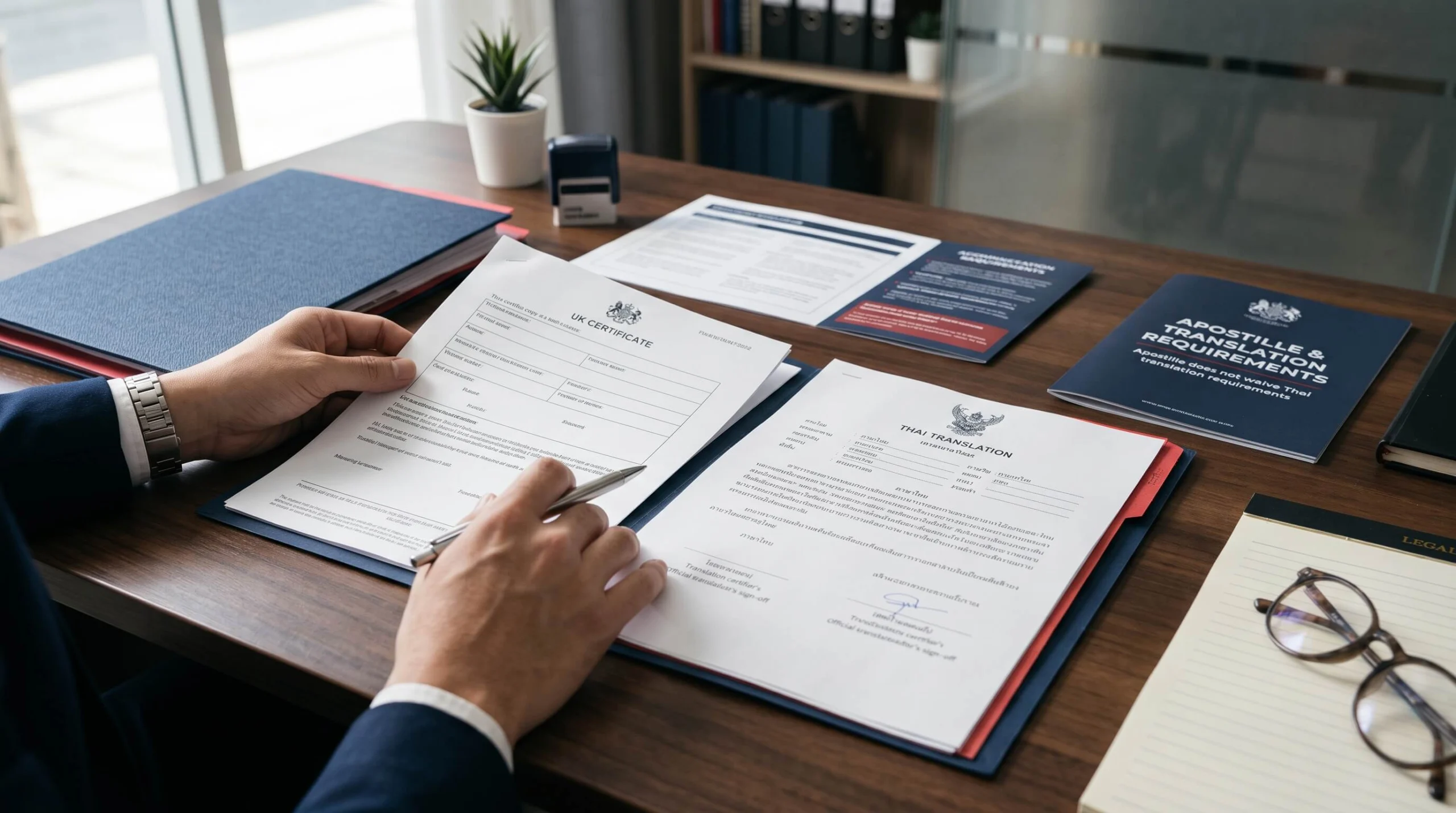
Should I legalise my documents now or wait?
Choose your route by the date you’ll submit the document in Thailand, not the date you legalise it.
Keep a scan or photo of your document after each stage. If a question comes up in Thailand, you’ll have a record of what was done.
To confirm your route, send us three things: the document type, the submission date, and the receiving authority’s written instructions.
Frequently asked questions (FAQs)
Here are answers to the questions UK senders most often ask about Thailand’s document legalisation changes following its accession to the Hague Apostille Convention:
Need to legalise UK documents for Thailand?
Until 28 February 2027, your documents need an FCDO apostille and Thai Embassy legalisation. After that, an apostille should be enough. Certification and translation rules apply either way.
London Apostille Services Ltd is registered with the FCDO and handles the UK stages for you, from certification to return delivery. Our team is on the phone from 8 am to 5 pm, and on live chat and email from 7 am to 7 pm, Monday to Friday.
Order online to see your full Thailand price, including embassy fees, before you pay. Online orders get a discount automatically.
Not sure what your documents need? Send us the authority’s instructions, and we’ll confirm the route.
We offer a refund guarantee if a document is rejected due to an error in our process.