
If you need to know who can certify a power of attorney, the law in England and Wales names 5 people who can do it. Anyone outside that list cannot, and a copy they sign has no legal effect.
Over 9.3 million lasting and enduring powers of attorney now sit on the register at the Office of the Public Guardian. Hardly any of the people holding one will post the original to a bank, because replacing a lost original costs money and weeks of waiting.
A certified copy is the answer, and it does the same job as the original once it’s certified properly.
Quick answer – Who can certify a power of attorney?
Section 3 of the Powers of Attorney Act 1971 sets out the full list, and Parliament last added to it in 2023.
5 people can certify a copy of a power of attorney in England and Wales:
Your GP, your accountant and your employer cannot certify a copy of your power of attorney, whatever their professional standing.
The difference between witnessing a signature and certifying a copy
Witnessing and certifying happen at different stages of a power of attorney’s life, and separate rules cover each.
Witnessing takes place while the document is being made. The donor signs the form, an independent adult watches them do it, and then signs underneath. Your witness doesn’t need to read the document or understand it. They confirm only that they saw you sign.
One rule is easy to miss. An attorney or replacement attorney cannot witness the donor’s signature. Attorneys can witness each other, just not the person appointing them.
Certifying comes later, usually once the document is registered. A certified copy proves that a photocopy matches the original, page for page.
| Witnessing a signature | Certifying a copy | |
|---|---|---|
| When it happens | While the power of attorney is being signed | After the document exists, usually once registered |
| What it proves | That the person signed the form | That the photocopy matches the original |
| Who can do it | Any adult over 18, though never an attorney, witnessing the donor | Only the 5 people named in section 3 of the 1971 Act |
| Where the rule comes from | Mental Capacity Act 2005 | Powers of Attorney Act 1971 |
| Video call allowed? | No, the witness has to be in the room | No, the certifier signs a paper copy in ink |
Who can certify a power of attorney? The UK legal shortlist
Which one you use comes down to 2 things:
Those factors also decide what you pay, from nothing to a few hundred pounds. Here’s how each certifier fits.
1. The donor
Certifying your own copies costs nothing, and you can do it for as long as you have mental capacity.
If you made the power of attorney, you can certify as many copies as you want. Certifying 6 copies the week your registration arrives and keeping them for later is perfectly acceptable.
Once you lose capacity, you lose the option. Your attorney then pays a professional for each new copy.
2. A solicitor
You’ll need a solicitor once the donor has lost capacity, or when a bank specifically asks for professional certification.
Solicitors price per copy, because every page needs its own wording, signature, and date. If your document is going overseas, the solicitor has to be FCDO-registered, which our solicitor certification service at London Apostille Services Ltd. covers.
3. A notary public
A notary costs more than a solicitor, and some overseas authorities ask for one specifically.
Notaries can travel to you, which helps if the donor is in a hospital or a care home. The solicitors in our network don’t provide mobile attendance or courier pick-up, so a notary is your option there.
Our notary public services handle certification for documents going anywhere in the world.
4. A chartered legal executive
The newest name on the list, added by the Powers of Attorney Act 2023 and in force since 18 November 2023.
Before that date, a chartered legal executive could draft your LPA (l) and still not be allowed to certify a copy of it.
Stephen Metcalfe MP, who sponsored the bill, told the Commons the task “does not require specialist legal skills”. Parliament agreed and added chartered legal executives to the list.
5. A stockbroker
Named in the 1971 Act, and almost never used in practice.
The Act refers to a member of a recognised stock exchange. If your power of attorney is being used to manage a share portfolio, a broker in that position qualifies.
Most people won’t need this route.
Certifying a power of attorney for use abroad
Overseas authorities need proof that whoever certified your document is genuine, which adds a step after certification.
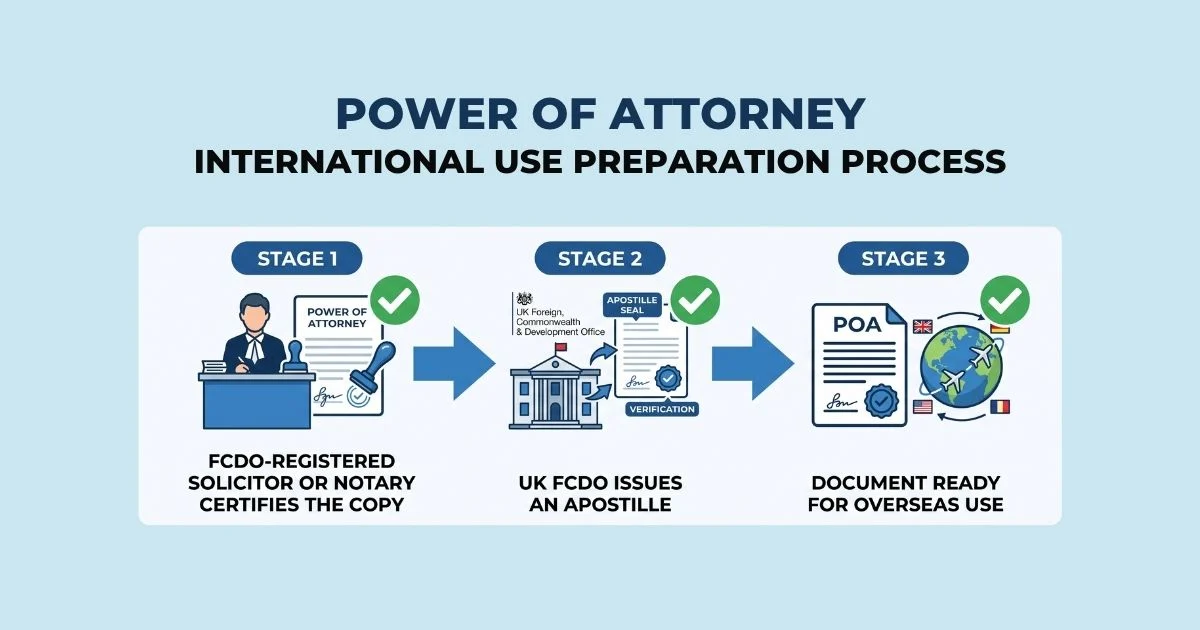
The order matters. An FCDO-registered solicitor or notary certifies the copy first, then the FCDO adds an apostille confirming the certifier’s stamp and signature are genuine.
Our power of attorney apostille service covers both stages together.
An apostille is enough for the 127+ countries in the Hague Convention. Spain, France, Australia, and China are all members.
Countries outside the Convention need an extra step. Qatar, Egypt, and Kuwait each require embassy attestation after the apostille, which adds time and cost.
The FCDO charges £45 for a paper apostille and £35 for the electronic version. Those are the government fees alone, so the price you pay also includes our admin fee and the solicitor or notary’s charge.
Tell us where the document is going, and we’ll price the whole route in one quote. Get a custom quote today.
Why not every professional can certify power of attorney documents
Certifying a passport copy and certifying a power of attorney follow separate rules, which is where the confusion starts.
For everyday documents, GOV.UK accepts certification from a wide range of people in “good standing”. For example, teachers, accountants, GPs, councillors, and bank officials.
Powers of attorney sit under their own legislation. Section 3 of the Powers of Attorney Act 1971 names the certifiers, and the list is closed. An accountant’s certification of your LPA has no legal effect.
Banks add to the confusion by publishing their own lists of acceptable certifiers for identity checks. Those lists apply to ID documents. They don’t extend the statutory list for powers of attorney.
Adding one profession to that list in 2023 needed an Act of Parliament, which shows how narrowly it’s drawn.
Why certified copies of a power of attorney may be rejected
Rejection usually comes down to how the copy was certified rather than a problem with the power of attorney itself.
The Office of the Public Guardian turned down 50,918 power of attorney applications in 2023/24, roughly 3.7% of the 1.37 million it received.
Those refusals happened at the registration stage. No equivalent figure exists for copies bounced by banks and registries afterwards.
What a correctly certified copy looks like
A certified copy of an LPA is a photocopy with a specific sentence written at the bottom of every page.
On each page, the certifier writes:
I certify this is a true and complete copy of the corresponding page of the original lasting power of attorney.
On the final page, whether that’s section 11 or a continuation sheet, the wording changes slightly:
I certify this is a true and complete copy of the lasting power of attorney.
Every page also needs the certifier’s signature and the date. For an enduring power of attorney, replace “lasting” with “enduring” and keep the rest the same. GOV.UK sets out the full certification wording if you want to check your own copy against it.
When a professional certifies, they add their name, profession, business address, and phone number so the receiving organisation can contact them.
The reasons copies come back
| Reason for rejection | What went wrong |
|---|---|
| Missing or altered wording | The certification sentence was reworded, shortened or left off entirely |
| Only the last page certified | Every page needs the wording, a signature and a date |
| Certifier not on the list | A family member, an accountant or the attorney themselves signed it |
| Certified too long ago | Many banks want certification carried out in the last 3 months |
| A copy of a copy | Someone photocopied a certified copy and sent it on |
| Black and white | Several banks insist on colour so the ink is visible |
| Pages missing | Continuation sheets left out, or the copy stops short of the final page |
| The LPA isn’t registered | An unregistered LPA can’t be used, so a copy of it can’t either |
| Sections 12 to 15 written on | Certifying an unregistered LPA across the registration pages voids it |
Triodos Bank asks for colour copies with the certification on every page, and won’t accept anything certified more than 3 months earlier. Most banks apply similar rules, though few publish them as clearly.
Section 3 of the 1971 Act does technically permit a certified copy of a certified copy. Banks rarely accept them, so we suggest going back to the original.
Can a power of attorney be certified digitally?
Certification still needs a pen, paper, and wet ink on every page.
Everyone signing an LPA has to sign the same original. Digital signatures aren’t accepted. The same applies to certification, so a scanned PDF with a typed certification line won’t be accepted.
The Powers of Attorney Act 2023 contains provisions for digital LPAs. Only section 2 has been brought into force, on 18 November 2023, and that section added chartered legal executives to the certifier list.
The Schedule that would permit fully digital LPAs is not yet in force as of the time of writing.
The Office of the Public Guardian is building a digital make-and-register service, and it remains in testing rather than public use.
The existing online tool helps you fill the forms. You still print them, sign them in ink, have them witnessed in person and post them.
The apostille that goes on top is separate, and that step can be electronic. The FCDO issues e-apostilles, and you can check both versions online. We’ve only processed 850 e-apostilles so far, so paper is still the more common route.
One point to note: the FCDO deletes e-apostille files after 21 days for security reasons. If you lose the PDF, you’ll need to order a new one.

Frequently asked questions (FAQs)
Below are the questions we hear most often about certifying powers of attorney.
Get your power of attorney ready for official use
The rules are narrow, and the process is quick once you know them.
4 points to take away:
London Apostille Services Ltd. has handled UK document legalisation for over 15 years, and the business is FCDO-registered. We work with a network of FCDO-registered solicitors and notaries who can certify your power of attorney.
If your document is going overseas, we cover certification, the apostille, and embassy attestation for countries such as Qatar, Egypt, and Kuwait. Our next-day express service is the one most customers choose.
If a document is rejected because of a mistake at our end, you get a full refund. We’re open 8am to 5pm Monday to Friday, with online support running until 7pm.
Not sure which route your power of attorney needs? Send us the details, and we’ll come back with a clear, fixed price. Start your enquiry here.