
Has a change in your family circumstances made it necessary to alter your child’s surname?
Changing a child’s surname on a UK birth certificate is possible, but the process depends on specific legal requirements and factors such as parental responsibility.
This guide explains when you can change your child’s surname, the steps involved, and how to ensure the updated birth certificate can be used abroad.
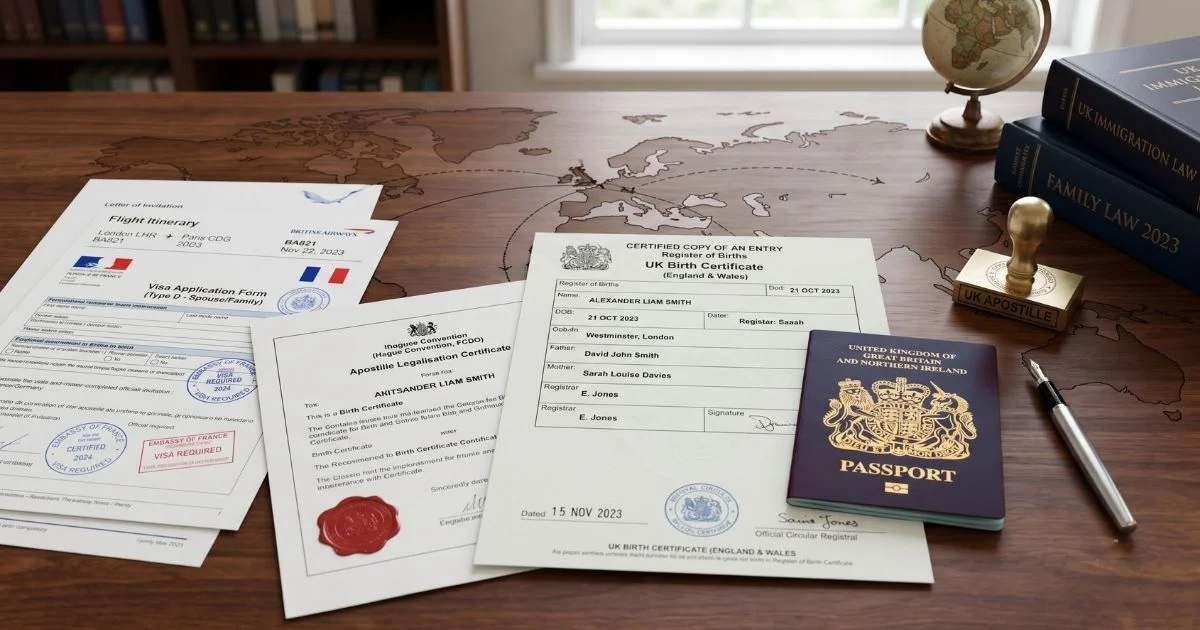
At a glance: How to change a child’s surname in the UK
The process to change your child’s surname depends on your specific circumstances.
Here are the common scenarios at a glance and the correct procedure:
Once your child’s surname has been legally changed, you should update their UK passport, as it is the primary proof of identity.
You should also update private documents in the child’s name, such as school, financial, and medical records. To ensure these documents are ready for use outside the UK, you must legalise them by getting an FCDO-issued apostille certificate.
We are London Apostille Services Ltd, an FCDO-registered firm, and we can help you navigate the document legalisation process end to end.
Request a custom quotation by telling us which documents you have and the country where they will be used.
When can a child’s surname be changed on official records?
Several life events can trigger a need to change a child’s surname on official records.
The common reasons include:
When you legally change a child’s surname due to any of the reasons above, you can update their legal name on official records. These records include passport, medical, banking, and school records.
The 3 main routes to changing a surname in the UK
The 3 main routes to changing a child’s surname in the UK are through an official GRO re-registration, deed poll, or court order.
Official GRO re-registration
This route applies under the following circumstances:
In either circumstance, the re-registration process ends with an updated birth register. A new birth certificate with the updated surname can be issued.
A deed poll
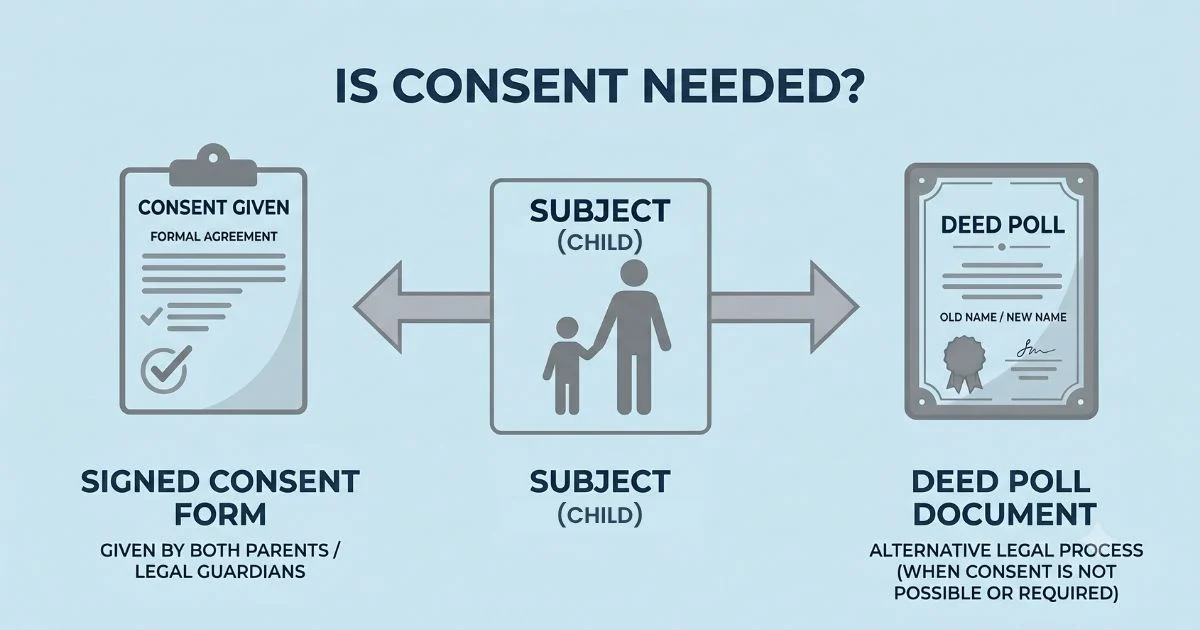
For a general surname change where re-registration does not apply, you will need a deed poll. It is a written statement declaring that you’ve dropped an old name and taken up a new one.
Since a child cannot make their own deed poll, a person with parental responsibility must do it for them. You will need consent from everyone with parental responsibility.
That said, while the deed poll changes the child’s legal name, it does not change the birth register. The birth certificate will continue to show the surname recorded at birth.
An official court order
If there’s more than one person with parental responsibility and one objects to a name change, the change cannot proceed with a deed poll alone.
In that case, you can apply to the Family Court for a Specific Issue Order. The court will consider the child’s welfare and interests and either grant or deny your request.
If the judge grants the order, you can use it to support a deed poll or use it directly to update official records. However, the birth certificate will continue to show the surname recorded at birth.
Steps to changing a child’s surname on a UK birth certificate
As we’ve seen above, the options to change a surname directly on a UK birth certificate are limited. It is generally only available to you through the official GRO re-registration, which applies when parents marry after birth or where the biological father was not recorded at birth.
However, whether you make the change through re-registration, deed poll, or court order, you can use the new legal name on all other official records.
That said, here are the steps to take to change a child’s surname in the UK:
- 1
Determine who has parental responsibility: Identify everyone who has parental responsibility. Generally, the mother’s consent is required, along with the consent of the father.
- 2
Obtain the necessary consent: Approach everyone with parental responsibility and request their permission to change the child’s surname.
- 3
Choose the appropriate route: If everyone with parental responsibility agrees, re-registration (if eligible) or a deed poll applies. If you don’t secure consent, you’ll submit a court application.
- 4
Update the child’s official records: Following the name change, you should update all relevant records, including passport, school records, medical records, and financial records.
Can I change a child’s surname without the father’s permission?
Whether you can change a child’s surname without the father’s permission depends entirely on whether he holds parental responsibility.
If you were married at birth or the father is listed on the birth certificate, you cannot change the child’s name via a deed poll without the father’s written consent.
If you were unmarried at birth and his name is not on the birth certificate, you can execute a deed poll without his permission.
Also, where the father has parental responsibility and refuses to grant permission (or is uncontactable), you may change the child’s surname by applying to the Family Court for a Specific Issue Order.
Do I need a solicitor to change my child’s name?
No, you generally don’t need a solicitor to change your child’s name.
If all parties consent, you can use a deed poll service or apply directly to the High Court to enrol the deed poll yourself.
However, you may need a solicitor if you institute a court process, and you want a solicitor to witness a signature or act as a commissioner for oaths when preparing court-bound documents.
That said, it’s always a good idea to get legal advice if there are parental disputes or international custody concerns.
Moving abroad or applying for international schools with a modified birth certificate
Foreign authorities and institutions expect documents where names match perfectly.
Because the name on the birth certificate and other documents may not match, you must present both the original birth certificate and the deed poll to explain the disparity.
However, to be able to use these documents overseas, they must be apostilled by the FCDO. An FCDO apostille verifies the signature or stamp of the issuing or certifying official. It does not confirm that the information contained within the document is accurate or true.
Here’s what you need to know about the FCDO:
London Apostille Services Ltd is one such FCDO-registered apostille facilitator.
We offer an expedited apostille service that will have your documents ready for use abroad as soon as the next working day (Express Service) or within 3 to 4 days (Standard Service). Our service includes document certification by an FCDO-registered London solicitor.
Contact us today to prepare your child’s documents for use abroad.
Frequently asked questions (FAQs)
Here are answers to some of the commonly asked questions about changing a child’s surname on a UK birth certificate.
How London Apostille Services Ltd can help
If you’re moving abroad or enrolling your child in an international school, updating their name on UK records is only one part of the process. To ensure foreign authorities recognise the paperwork, you must also legalise the documents for use overseas.
Navigating the legalisation process alone can be frustrating and time-consuming. At London Apostille Services Ltd, we manage the process on your behalf so you don’t have to.
Here’s how:
Ready to legalise your child’s documents for use overseas?
Get a no-obligation quote today by telling us which documents you have and where they are going.