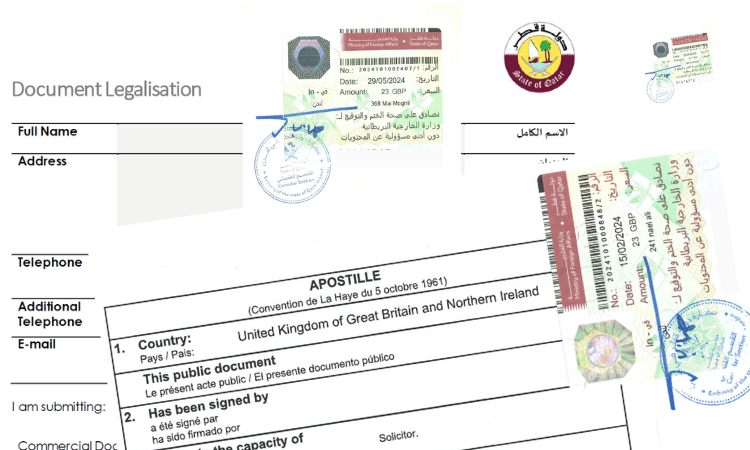
Documents we attest for the Qatar embassy
You can use our apostille and embassy attestation services to legalise all types of eligible documents, from simple educational documents to complex commercial ones.
Educational documents:
Educational certificates must be accompanied by the degree/diploma, its transcript, and a cover letter from the institution confirming the qualification’s authenticity, mode of study (full/part-time, distance/proximate), location of study and exams, awarded title, course duration, and exact study dates.
The following do not require a transcript or cover letter:
College certificates or diplomas;
Further Education certificates including A-Level, BTECH, NVQ, HNC, HND, Level 1-3;
Secondary Education certificates include GCSE;
Primary School certificates.
Please note that certificates obtained through distance or online learning programmes will not be accepted for legalisation, as per the regulations of the Ministry of Foreign Affairs in Doha.
Commercial documents:
Commercial documents like certificates of origin, invoices, packing lists, etc., must be attested by the London and Arab-British Chambers of Commerce before submission to the Embassy.
Some commercial documents, including invoices, Probates, Powers of Attorney, certificates of origin, or any document mentioning a monetary amount, may incur an ad valorem fee (a fee based on the document’s value).
These documents must be accompanied by a Commercial Invoice.
If submitting multiple invoices, ensure they share the same date and specify the number of bills.
We will inform you in advance if any extra charges arise during the certification process.
Foreign documents:
The Embassy of the State of Qatar in London accepts foreign documents originating from:
- Norway
- Iceland
- Jersey
- Guernsey
- Isle of Man
- Channel Islands
- The Republic of Ireland
- and British Overseas Territories
These must be verified by their respective country’s Ministry of Foreign Affairs before submission to the Embassy for further processing.
Documents from British Overseas Territories require a two-step apostille process:
- first in their region of origin
- then by the UK FCDO before they can be submitted to the Embassy.
Documents from Crown Dependencies only need an apostille from their region of origin before submission to the Embassy.
and British Overseas Territories
These must be verified by their respective country’s Ministry of Foreign Affairs before submission to the Embassy for further processing.
Documents from British Overseas Territories require a two-step apostille process:
first in their region of origin
then by the UK FCDO before they can be submitted to the Embassy.
Documents from Crown Dependencies only need an apostille from their region of origin before submission to the Embassy.
 Skip to content