
Are you preparing for a marriage, academic, or work engagement in a country where English isn’t an official language?
Apostilling your UK document as is will likely not be enough. You may also be required to either translate the apostilled document or translate it first, then get it apostilled.
This post explains how to get a document translated and apostilled to meet the specific requirements of the requesting authority and how to find experts to help you navigate the process.
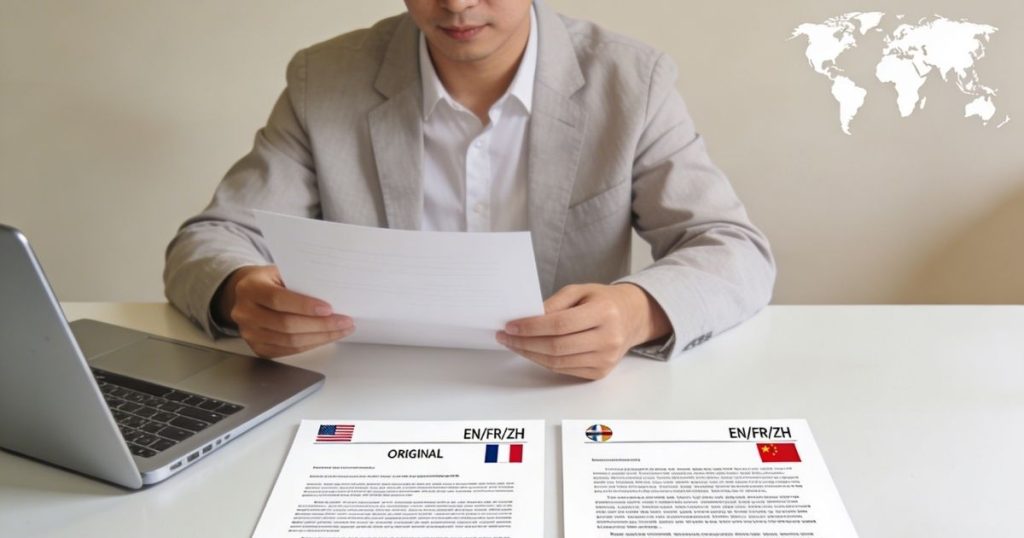
TL;DR – How to get UK documents translated and apostilled
The standard procedure is to apostille a document first, then translate it.
If this is what’s required of you, here’s the process at a glance:
When both translation and apostille are required
There are instances in which the requesting authority explicitly requests that the underlying document be translated. In this case, you must prepare an apostille-ready translation.
First, you’ll use a fully qualified sworn translator to translate the document naturally and accurately. The translator must preserve the original intent and style.
Second, you’ll make the document apostille-ready by having an FCDO-registered solicitor verify the authenticity of the translator’s signature and identity/status. You can then submit the certified translation to the FCDO for an apostille.
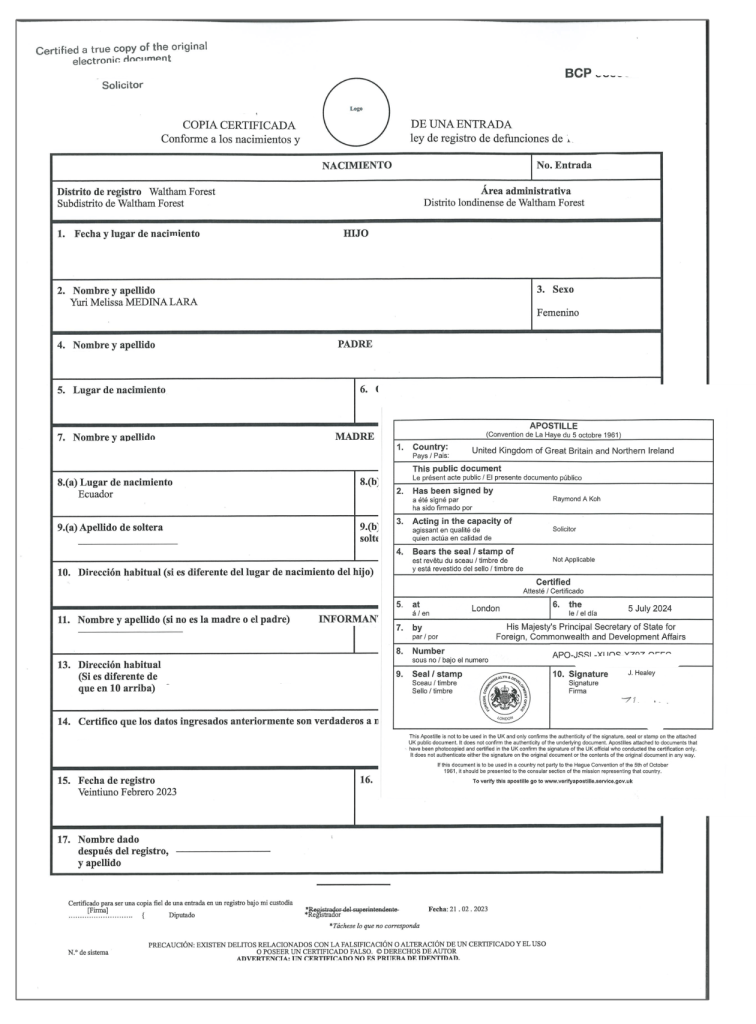
Should you translate UK documents first or apostille first?
The decision on whether to translate or apostille first depends entirely on the requesting authority.
In the absence of explicit instructions, the default procedure is to apostille the document first, then translate it.
However, we’ve encountered situations in which an authority requests that the translation itself be apostilled. Therefore, it makes sense to confirm what the specific requirements are before proceeding.
How to get a document translated and apostilled correctly
The goal of navigating this process is to confirm the authenticity of your UK documents and ensure their contents are understood in your destination country.
To achieve this, there are 3 processes you must get right: document certification, document legalisation, and document translation.
The certification process
When the FCDO apostilles a document, it verifies the authenticity of the signatures and stamps on it.
If your document is a government-issued original, you can submit it to the FCDO as is for an apostille.
The FCDO can easily verify signatures and stamps issued by the General Register Office (GRO) or government officials because they have the details in their database.
However, if it is a private document, it must be certified by a solicitor first. Specifically, you should use an FCDO-registered solicitor.
The legalisation process
Document legalisation is the process of verifying the authenticity of your UK documents so authorities in other countries can legally accept/recognise them.
It involves getting an apostille certificate from the FCDO. However, if your destination is a country like Qatar, Egypt, or Kuwait that is not a party to the Hague Apostille Convention, an additional step (consular legalisation) is required.
In the consular legalisation step, you’ll submit the apostilled document to the relevant embassy in London for attestation.
The translation process
Where translation is required, it must be handled by a qualified professional. It must capture the original intent and style of the document.
It’s best to use a sworn translator who has handled documents for your specific destination. They can help you meet the unique requirements of your requesting authority.
At London Apostille Services Ltd., we’ve handled document legalisations and translations for many popular destinations, and we can help you navigate the process correctly.
Using our services, you get:
Contact us today to get your document translated and apostilled correctly the first time.
Processing times and cost considerations
Many requests for document legalisation are often time-sensitive. Unfortunately, the DIY route, where you submit a document directly to the FCDO for an apostille, can take over 3 weeks.
That said, the FCDO has registered business users you can leverage to get your document apostilled much faster. London Apostille Services Ltd. is one such service.
We have expedited apostille processing times, which are priced as follows:
The cost competitiveness extends to the translation service, too. Here’s a breakdown of our pricing levels for document translation:
Note: One page equals a maximum of 250 words.
Additional optional costs are as follows:
Additionally, you should budget for the cost of delivering and returning your documents. You can drop off/pick up your documents at our office in person or send/receive them via Royal Mail or DHL.
How to check your documents before apostille and translation
Rejections by the FCDO or the requesting authority can be costly in both time and money. To increase the chances that your documents are accepted on the first submission, we recommend you check the following:
Frequently asked questions (FAQs)
Below are answers to some commonly asked questions about how to get a document translated and apostilled.
Find a reliable apostille translation service
The apostille and translation processes are separate, but you don’t have to do them without close coordination. When you let separate entities facilitate the two processes, mistakes can happen, leading to your document being rejected.
At London Apostille Services Ltd., we provide an end-to-end service, facilitating solicitor certification, FCDO apostille acquisition, and document translation.
Our approach helps you avoid the following issues that may cause a rejection:
Contact us today to get your document translated and apostilled correctly and to avoid unnecessary delays.
![Statutory declarations – what you need to know [+ free form templates]](https://apostillelondon.com/wp-content/uploads/2026/04/Statutory-declarations—-what-you-need-to-know-500x383.webp)