
We regularly encounter people who request an apostille when what they need is a notarial certificate. Additionally, people often request notarial certificates when the required document needs an apostille.
The notary vs apostille certificate confusion can be costly in both time and money, especially when you need the documents for a time-sensitive overseas job or business opportunity.
This post outlines the key differences between the two documents and provides pointers on how to obtain them.
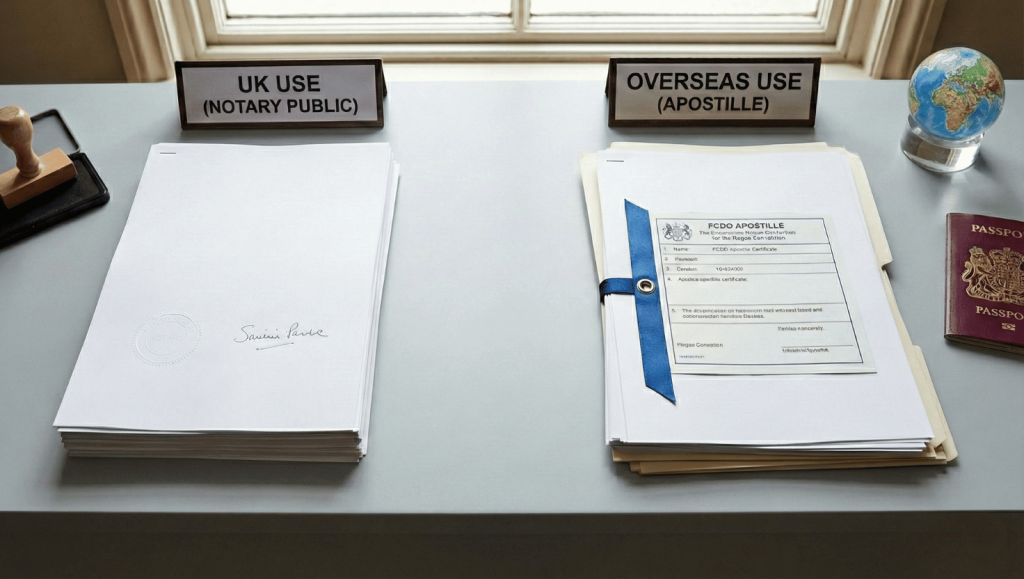
Apostille vs. notary at a glance
Here’s a quick summary of the purpose and authorised issuers of apostille and notary certificates:
| Apostille | Notary | |
|---|---|---|
| Purpose | An apostille confirms that the signature and stamp on your document are genuine. It gives foreign entities the confidence to accept your document. | A notary certificate confirms that a transaction was conducted in a lawful manner. |
| Who issues it | In the United Kingdom, the Foreign, Commonwealth and Development Office (FCDO) issues apostilles. | Notaries public (simply referred to as “notaries”) issue notary certificates. |
What is an apostille?
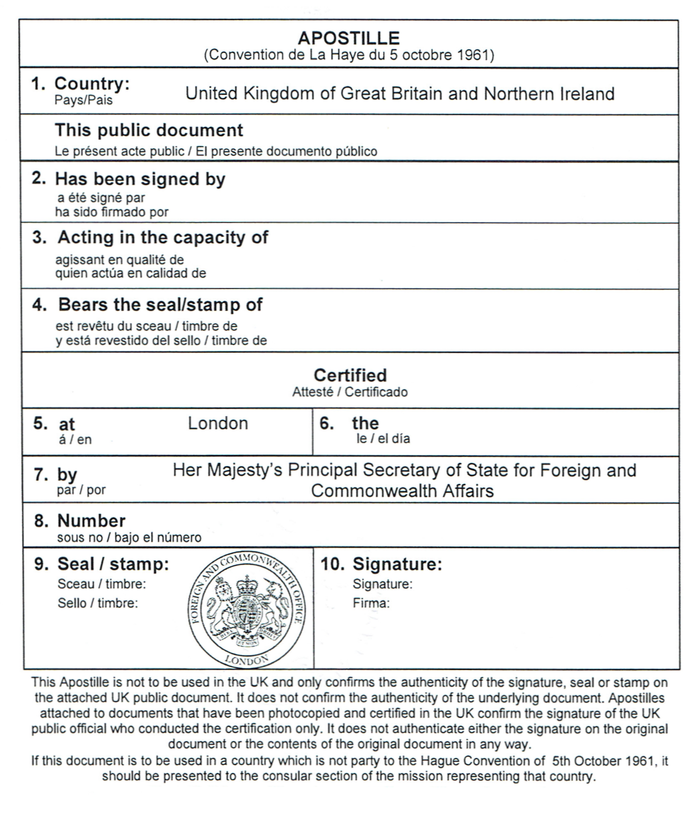
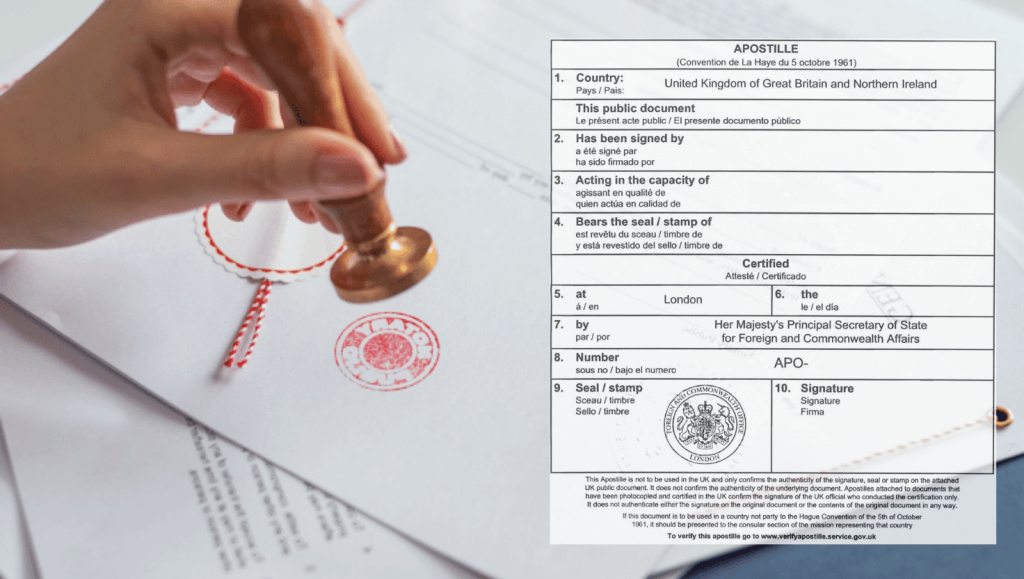
An apostille is a certificate issued by a designated government body that authenticates documents for use in other countries.
However, it does not authenticate the actual contents of your document. What it does is authenticate the identity and authority of the person whose stamp and signature appear on the document.
For instance, the FCDO maintains a database of solicitors’ signatures and stamps. If you submit a document certified by a solicitor, the FCDO will compare the signatures and stamps on the document with those in their database.
If the details match and the FCDO is satisfied that the document is genuine, it will issue an apostille, allowing the document to be recognised in countries that are party to the Hague Apostille Convention.
Documents requiring an apostille stamp
The following documents typically require an apostille before they can be accepted by overseas authorities.
Because requirements vary by destination country, it’s essential to confirm the document legalisation requirements with the requesting authority before proceeding.
Additionally, you can save time and eliminate uncertainty by leveraging the expertise of an apostille facilitator.
We are an FCDO-registered apostille agent. We can manage the apostille process on your behalf, ensuring your documents are prepared correctly for your specific destination.
Contact us today for an end-to-end apostille service that prevents costly rejections.
What is a notary?
A notary is an internationally recognised legal professional appointed by the government to verify identity, intent, and the authenticity of documents.
While many other legal professionals, such as solicitors, have a duty to their clients, a notary’s duty is to the transaction itself. A notarial act attests to a transaction having been executed lawfully.
For instance, a notary can attest that you signed a document willingly and after having understood the legal consequences of appending your signature to it.
Key notarial acts
A notary can carry out the following acts:
For all these acts, the duty of the notary is not complete until they attach or complete a written statement (the certificate) that details what took place during the notarial act.
Key differences between an apostille and a notary
Here are the key differences between an apostille and notarial acts:
| Apostille | Notary | |
|---|---|---|
| Action | Verify the official whose signature/stamp appears on the document. | Witnesses the signer or oath-taker. |
| Issuing authority | The FCDO. | Notaries public. |
| Recognition | International, specifically in countries that are party to the Hague Apostille Convention. | Domestic and International |
| Can it be used alone? | Yes, but with the underlying document. | Yes, domestically. Internationally, you may also need an apostille. |
| Format | A standardised certificate. | A textual statement, plus the notary’s signature and stamp. |
| Cost basis | Statutory fees. The FCDO charges £45 for the standard apostille. | Depends on the notary’s professional fees. |
| Typical turnaround time | Varies, and can take up to two weeks. Working with an agent, you can get it the next working day. | Same-day turnaround. |
When you need an apostille, but not a notary
In some cases, you can prepare documents for use abroad with an apostille alone, without first having them notarised. It’s the case when you have a government-issued original, like a birth or marriage certificate.
When the FCDO legalises a document for use abroad, it verifies the authority of the person who signed or stamped it.
Because the FCDO can independently verify government-linked signatures and stamps, there’s no need for prior independent certification by a notary or solicitor when submitting an original government document for an apostille.
When you need a notary, but not an apostille
If you plan to use a document only in the United Kingdom, getting a notary certificate should be sufficient. You will not need an apostille.
Additionally, in some international engagements, the requesting authority may request notarisation alone, without an apostille. Even so, if the destination country is not a member of the Hague Apostille Convention, you should confirm whether embassy attestation is required instead.
Cases when you need both: The full legalisation process
The safest bet when preparing your documents for use abroad is to get both notarisation/certification and an apostille certificate. It applies when you are submitting documents that aren’t government-issued originals.
First, you’ll get your documents notarised by a notary public or certified by a solicitor. You’ll then submit your documents to the FCDO for an apostille.
Here are some key insights about the FCDO legalisation process:
Navigating government bureaucracy alone can be overwhelming and time-consuming. We streamline the process, doing the heavy lifting so you can get your documents apostilled quickly and correctly.
Here’s what you get when you work with us:
Contact our team today to legalise your documents for use abroad. We’ll provide expert advice relevant to your destination country.
Bottom Line
Ultimately, whether you need an apostille certificate, a notary certificate, or both depends on the document and where it is going.
For most domestic uses, you’ll only need notarisation. For use abroad, you may need an apostille and/or embassy attestation.
That said, to avoid costly errors and rejections, it is best to consult with a specialist like London Apostille Services Ltd. before proceeding with either process.
Frequently asked questions (FAQs)
Here are answers to some of the commonly asked questions about notaries and solicitors:

![Statutory declarations – what you need to know [+ free form templates]](https://apostillelondon.com/wp-content/uploads/2026/04/Statutory-declarations—-what-you-need-to-know-500x383.webp)