
A statutory declaration is one of those legal documents most people only hear about when they urgently need one.
Whether you are getting married abroad, changing your name, or proving your identity for an overseas authority, a statutory declaration puts your statement on the record in a legally binding way.
Making a false one carries a criminal penalty under the Perjury Act 1911, so the process carries real weight.
This guide covers what a statutory declaration is, how to get one, who can witness it, and what to do when you need it apostilled for use outside the UK.
What is a statutory declaration?
A statutory declaration is a written statement of fact that you sign in front of an authorised legal professional, confirming the contents are true to the best of your knowledge.
It is governed by the Statutory Declarations Act 1835, and unlike an affidavit, it does not need to be sworn under oath or contain any religious text.
What makes it legally binding is the prescribed wording from the Act, combined with your signature made in the presence of an authorised witness.
The essence of a statutory declaration
What gives a statutory declaration its legal weight is the criminal liability attached to it. Under Section 5 of the Perjury Act 1911, knowingly making a false statutory declaration is a criminal offence carrying up to two years in prison.
The witness does not check whether what you are declaring is actually true. They are there to confirm who you are, watch you sign, and complete their section of the document. If the contents turn out to be false, that is on you.
When is a statutory declaration used?
They are broadly used as a formal statement when no other evidence or other statements or documents are available to confirm a truthful fact.
They are used as legal documents or evidence confirming a legal matter.
Examples are confirmation of declared marital status, address or identification of a person, and truthfully declared information in a patent application procedure when no other documents of such nature can be presented.
How to get a statutory declaration
The process is straightforward once you know the steps.
Here is what to do from start to finish:
- 1
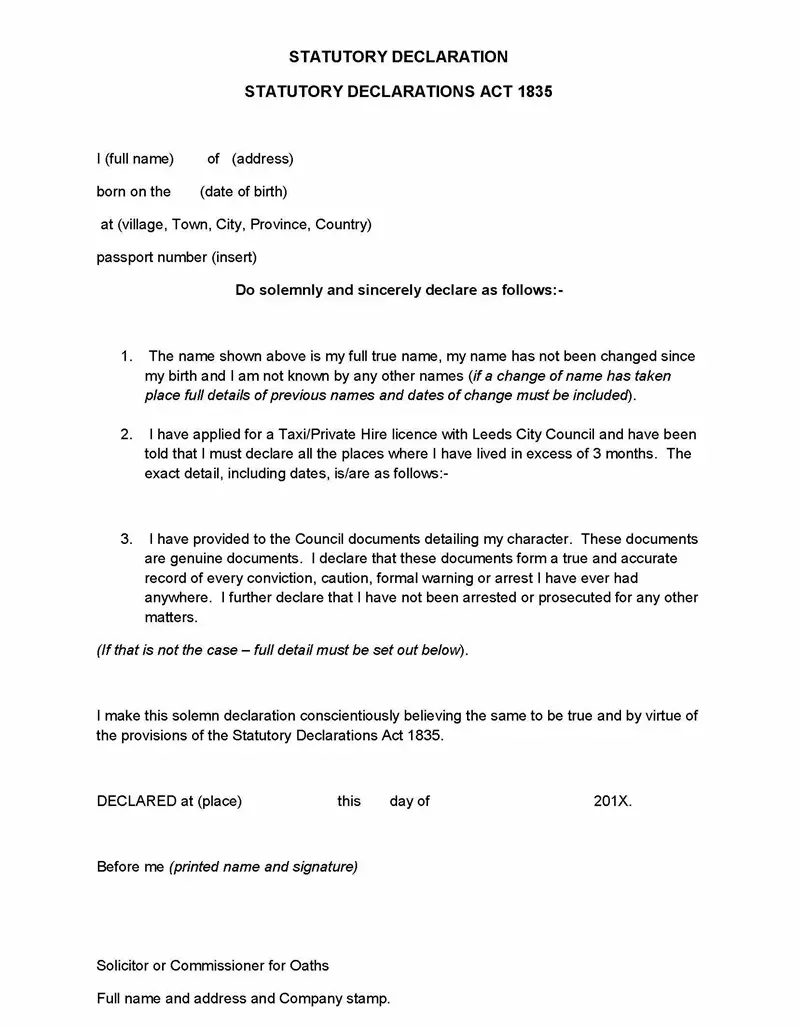
Draft the declaration: Write out the facts you need to declare in numbered paragraphs. You can do this yourself using a template (you can use the one below) or have a solicitor draft it for you. Either way, make sure the prescribed opening and closing wording from the 1835 Act is included.
- 2
Do not sign it yet: The declaration must be signed in front of an authorised witness. Signing it beforehand makes it invalid.
- 3
Book an appointment with an authorised professional: This can be a solicitor, notary public, justice of the peace, or commissioner for oaths. For domestic UK use, a solicitor is usually the most accessible option.
- 4
Bring valid ID: Bring a government-issued photo ID (passport or driving licence) and proof of address (a utility bill or bank statement no older than three months).
- 5
Sign in front of the witness: At the appointment, you will read and sign the declaration in the witness’s presence and confirm verbally that the contents are true.
- 6
The witness completes the jurat: The authorised professional adds their signature, printed name, qualification, address, and the date. This final section is what authenticates the document.
The whole process usually takes under 30 minutes. By law, the witnessing fee is £5 for the declaration and £2 for each exhibit attached to it, though many firms add a small appointment fee on top.
Who can sign a statutory declaration in the UK?
The declarations are to be signed before a solicitor, a notary public or a commissioner for oaths, although they are not to be sworn under oath.
Neither is there a requirement for statutory declarations to contain religious texts.
An interesting fact concerning statutory declarations is that bodies such as the University of Cambridge and Oxford may be able to substitute a declaration in lieu of an oath to execute bylaws or statutes, as long as such are duly passed according to the university’s regulations.
The act prescribes the declarations to be signed in the presence of other authorised persons overseas or in case needed abroad.
Do you need a statutory declaration solicitor or a notary public?
For most purposes within the UK, a solicitor is perfectly sufficient to witness a statutory declaration. Any solicitor with a valid practising certificate is automatically authorised to act as a commissioner for oaths under the Solicitors Act 1974.
One important rule is that the solicitor witnessing the declaration cannot be the same solicitor acting for you in the matter the declaration relates to. An independent solicitor must witness it.
When a notary public is the better choice
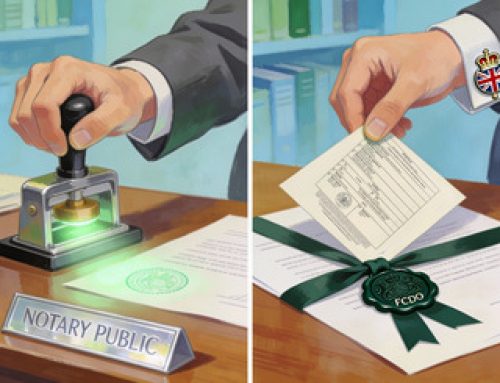
If your statutory declaration is going to be used outside the UK, a notary public is often the stronger option. A notary can affix their official seal to the document, which is what most foreign authorities and embassies expect before they will accept it.
Both a solicitor’s and a notary’s signature is accepted by the FCDO for an apostille, as long as the professional is FCDO-registered.
That said, many overseas institutions will specifically ask for notarisation rather than solicitor certification, especially in countries across Europe, the Middle East, and Asia.
If there is any doubt, check what the receiving authority in the destination country requires before booking your appointment. Choosing the wrong route can cause delays.
Not sure which option applies to your situation? London Apostille Services Ltd. have over 15 years of experience in document legalisation, we know exactly what different countries and authorities require.
Contact our office today, and we will point you in the right direction.
Download our free, editable statutory declaration templates (word templates)

Statutory declaration costs
The Statutory Declarations Act 1835 provides for the fees of the execution of a statutory declaration to be paid upon execution, when signed in the presence of the competent authority, be it a solicitor, a commissioner for oaths or a notary public.
The Statutory Declarations Act 1835 does not envisage a specific fee itself.
Still, it is considered for an authority to charge no less than £5 per signatory and £2 per every exhibition to the statutory declaration.
Legalising statutory declarations for overseas use
As above, statutory declaration statements must be legalised if they are intended to be used overseas (outside the UK).
Since a solicitor or notary has already signed the statutory declaration, no further certification is required to get a apostille from the FCDO legalisation office.
Either send your documents directly to the Legalisation Office (processing times can take up to 20 days) or use an FCDO-registered legalisation agency to expedite the legalisation process, usually one or two days.
In most cases, an emergency same-day apostille can also be arranged.
Frequently asked questions (FAQs)
Below are some of the most common questions about statutory declarations, particularly for those who need one for international use.
Get your statutory declaration witnessed or apostilled today
If you need a statutory declaration witnessed by an FCDO-registered solicitor or notary public, or you need an existing declaration apostilled for use abroad, London Apostille Services Ltd. can help.
Our standard apostille service for statutory declarations starts from £87 per document, with a next-day express option available from £97. We also offer solicitor certification and notarisation as part of the same order if your declaration still needs to be witnessed.
Apostille for statutory declarations
Our guide explaining on how to order a statutory declaration.
General information purposes (disclaimer)
This article does not constitute legal advice or a provision of legal services. The article is aimed only for general information regarding the nature of statutory declarations.