
Changing your name in the UK doesn’t always require a deed poll.
A statutory declaration for name change offers a formal, legally recognised alternative that’s particularly useful if you’re in Scotland or need your documents authenticated for international use.
This guide explains what statutory declarations are, when you need one, and how to get yours sorted properly.
What is a statutory declaration of name change?
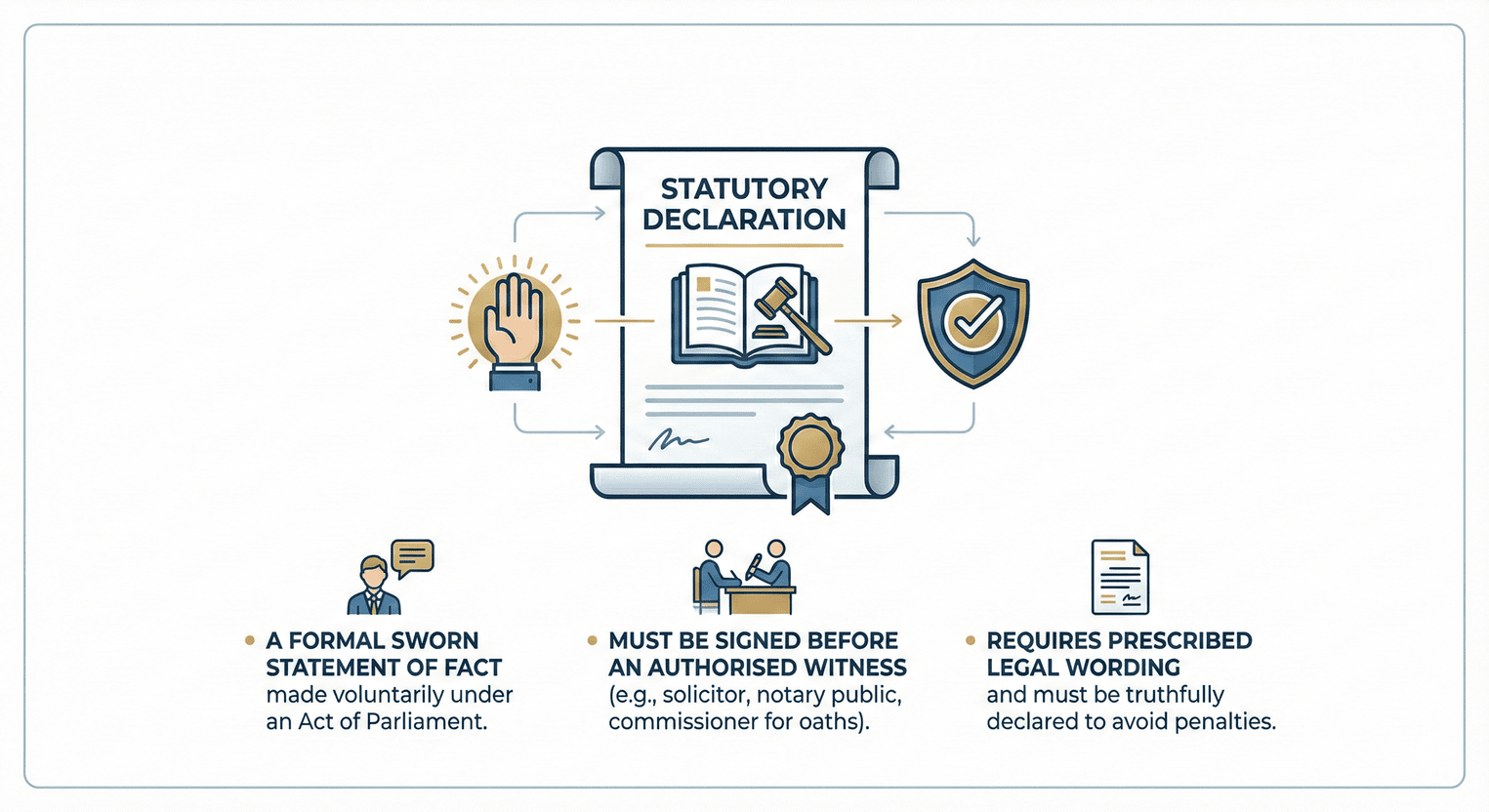
A statutory declaration is a written statement you make under oath, confirming you’re abandoning your old name and adopting a new one.
It’s governed by the Statutory Declarations Act 1835, which makes it a legally binding document.
The key difference from other name change documents is that you must sign it in front of an authorised person, usually a solicitor, notary public, or commissioner for oaths.
They’ll verify your identity, watch you sign, then add their own signature and official stamp.
The declaration must include the prescribed legal wording from the Statutory Declarations Act 1835, confirming you conscientiously believe the declaration to be true under the provisions of that Act.
HM Passport Office and other government bodies may reject your document without this exact wording.
Making a false statutory declaration is a criminal offence under the Perjury Act 1911, punishable by up to two years in prison.
Statutory declaration vs. deed poll: key differences
Both documents legally change your name, but they work differently.
Here’s how they compare:
| Feature | Statutory Declaration | Deed Poll |
|---|---|---|
| Witness requirement | Must be signed before a solicitor, notary, or commissioner for oaths | Any independent adult over 18 can witness |
| Can be enrolled | No | Yes (£50.32 at Royal Courts of Justice) |
| Best for | Scotland, international use, non-UK citizens | England, Wales, Northern Ireland (domestic use) |
| Legal weight | Higher formality due to the oath requirement | Legally valid but less formal |
| International acceptance | Widely accepted, especially when notarised | Often rejected by foreign authorities |
In Scotland, statutory declarations are the standard method for changing your name. Deed polls aren’t commonly used or recognised by Scottish authorities. If you live north of the border, you’ll almost certainly need a statutory declaration.
For international use, statutory declarations are often preferred. Many foreign governments and embassies require documents that have been notarised or witnessed by legal professionals, which a standard deed poll doesn’t provide.
If you’re planning to use your name change document abroad, you’ll likely need it apostilled. London Apostille Services Ltd can help you apostille your statutory declaration or apostille your deed poll for international recognition.
When to use a statutory declaration for changing your name
You’ll need a statutory declaration instead of a deed poll in several situations:
Steps to changing your name with a statutory declaration
Getting a statutory declaration is straightforward.
Here’s what you need to do:
The whole process usually takes less than 30 minutes once you’re at the appointment.
UK statutory declaration template and wording example
Your statutory declaration must contain specific wording to be legally valid.
You can download our free statutory declaration template that includes all the required legal language, or use the format below:
STATUTORY DECLARATION OF CHANGE OF NAME
I, [New Full Name] (formerly [Old Full Name]), of [Your Full Address], DO SOLEMNLY AND SINCERELY DECLARE as follows:
- I was formerly called [Old Full Name] and am a citizen of the United Kingdom.
- I absolutely and entirely renounce, relinquish, and abandon the use of my former name of [Old Full Name] and assume, adopt, and determine to take and use the names of [New Full Name] in substitution of my former name.
- I shall at all times hereafter in all records, deeds, documents, and other writings and in all actions and proceedings, as well as in all dealings and transactions and on all occasions whatsoever, use and subscribe the said name of [New Full Name] in substitution for my former names of [Old Full Name] so relinquished as aforesaid.
- I authorise and require all persons at all times to designate, describe, and address me by the adopted name of [New Full Name].
AND I make this solemn declaration conscientiously believing the same to be true and by virtue of the provisions of the STATUTORY DECLARATIONS ACT 1835.
Signed: _________________ (as [Old Name])
Signed: _________________ (as [New Name])
DECLARED at [Location] this [day] day of [month] [year] before me [Witness name and designation]
The witness section is completed by your solicitor or notary. Don’t fill that bit in yourself.
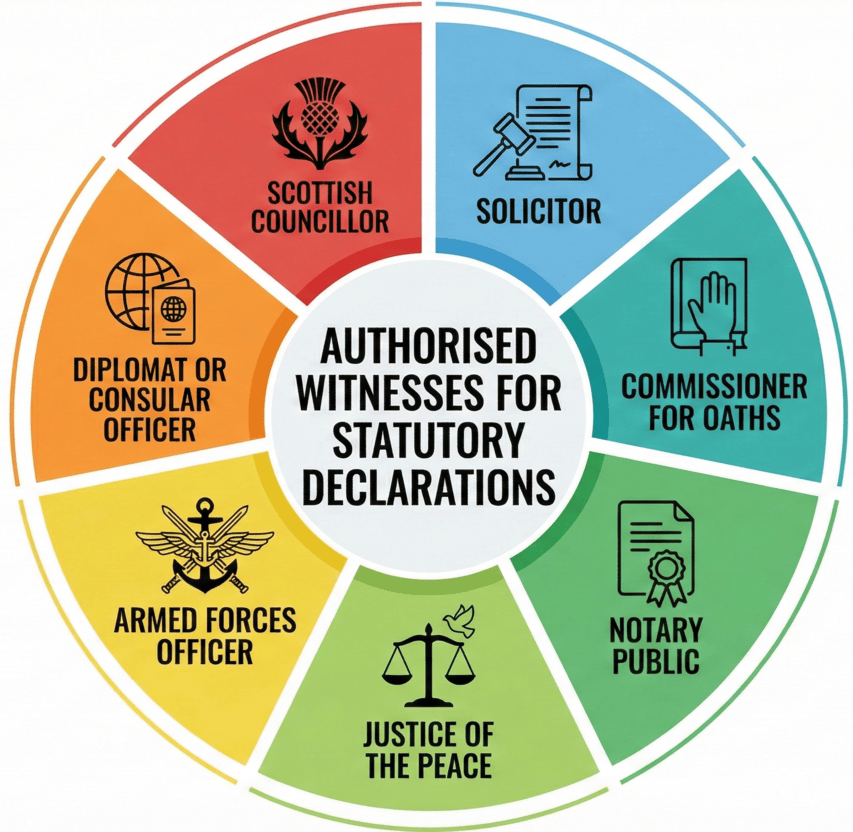
Who can sign a statutory declaration in the UK?
Not everyone can witness a statutory declaration.
The law restricts it to specific authorised people:
Your witness must be independent. They can’t be related to you, acting as your legal adviser on a connected matter, or involved in drafting the document.
They need to verify your identity before witnessing your signature.
Legalising your name change declaration for overseas use
If you’re using your name change document abroad, it usually needs additional authentication.
The process depends on which country you’re dealing with.
For Hague Convention countries
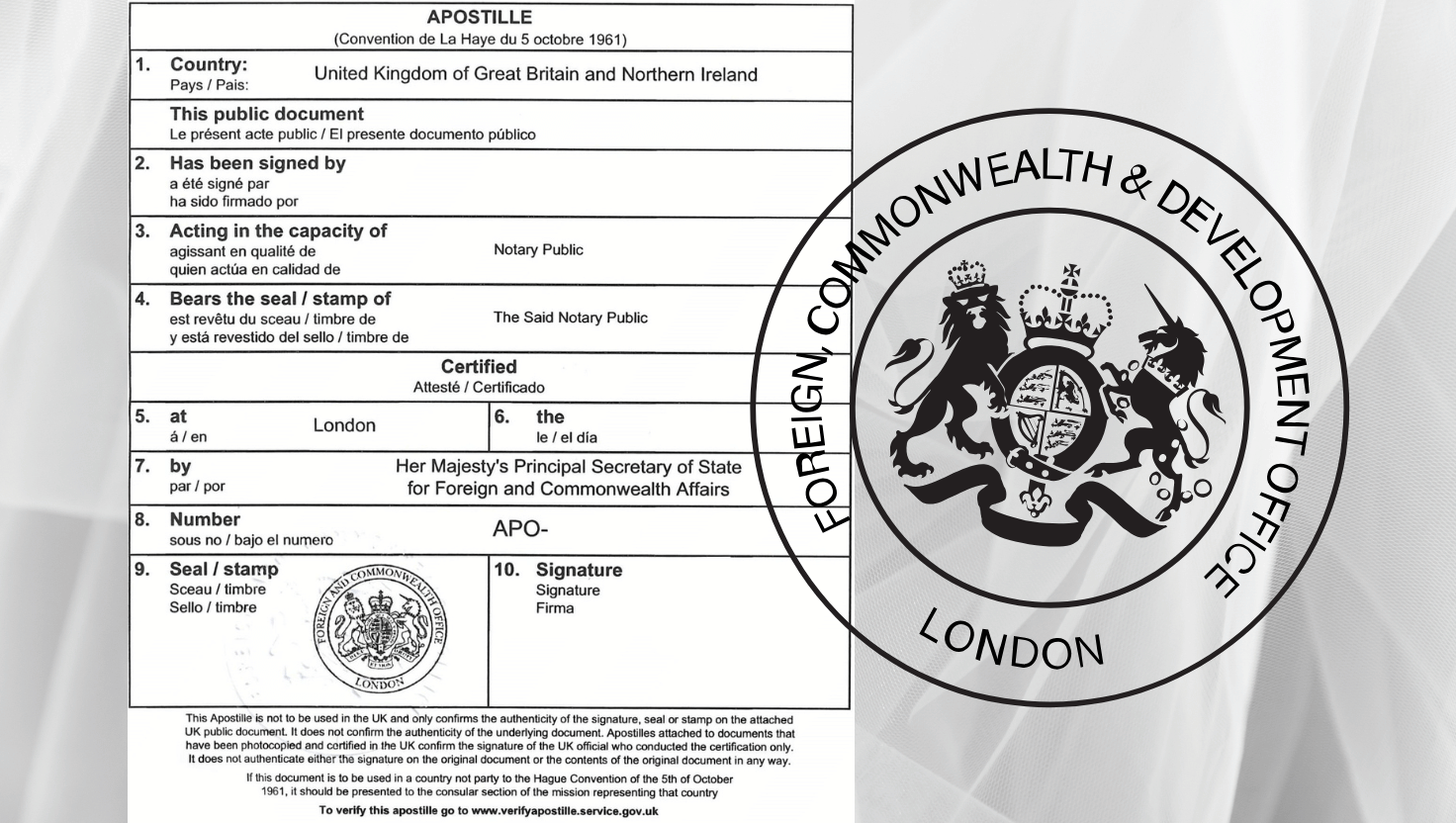
For countries that are party to the Hague Apostille Convention (including all EU nations, the USA, Canada, Australia, and over 120 others), you need an apostille from the FCDO Legalisation Office.
An apostille is an official certificate that confirms your document is genuine.
The FCDO offers two service options:
- 1
Standard apostille: £45 per document, processed within three or more weeks
- 2
e-Apostille: £35 per document, processed within two working days
For your statutory declaration to be apostilled, it must be witnessed by a solicitor or notary whose signature the FCDO can verify.
Starting with a notary public makes the process smoother if you know you’ll need international authentication.
For non-Hague countries
Countries not part of the Hague Convention (such as the UAE, Qatar, Kuwait, and Egypt) require a more complex process called embassy attestation.
Here’s what you’ll need:
- 1
Get your FCDO apostille first
- 2
Take the apostilled document to the relevant embassy in London
- 3
Pay for their attestation stamp (fees vary by embassy)
- 4
Wait for processing (can take several weeks)
This multi-step process can be time-consuming, especially if you’re unfamiliar with embassy requirements or working to tight deadlines.
Let us handle your document legalisation
Getting an apostille through the FCDO directly means:
- 1
Handling the paperwork yourself,
- 2
Posting documents,
- 3
Waiting weeks for processing, and
- 4
Dealing with any rejections if something’s not right.
Without FCDO registration, you’re stuck with these long timelines.
That’s why people use London Apostille Services Ltd to handle the entire legalisation process, from notarisation through to apostille and embassy attestation.
As an FCDO-registered agent, our next-day service (our most popular option) gets your apostille the next business day, and our standard UK apostille service processes it in three to four business days.
With over 15 years of experience, we make sure your documents are properly authenticated the first time, saving you the hassle of resubmissions and delays.
Get in touch with us today to discuss your document legalisation needs.
Frequently asked questions (FAQs)
Here are answers to common questions about statutory declarations and name changes: