

When applying for legalisation, you may be asked to provide a certified copy of your documents. The certification confirms the validity of a document and is used as a tool against fraud.
As such, you must seek the services of a qualified UK solicitor, notary public, or the relevant authorities to get your documents certified.
The certification assures requesting authorities that your documents(s) are a true copy of the original.
This guide examines what a certified copy is – when a certified copy is required, who can certify a document and what format the certification should take, and the use of certified copies for the purpose of legalisation.
TL;DR – How to certify documents
If you’re short on time, here’s what you need to know about certifying documents in the UK:
What is a certified copy of documents?
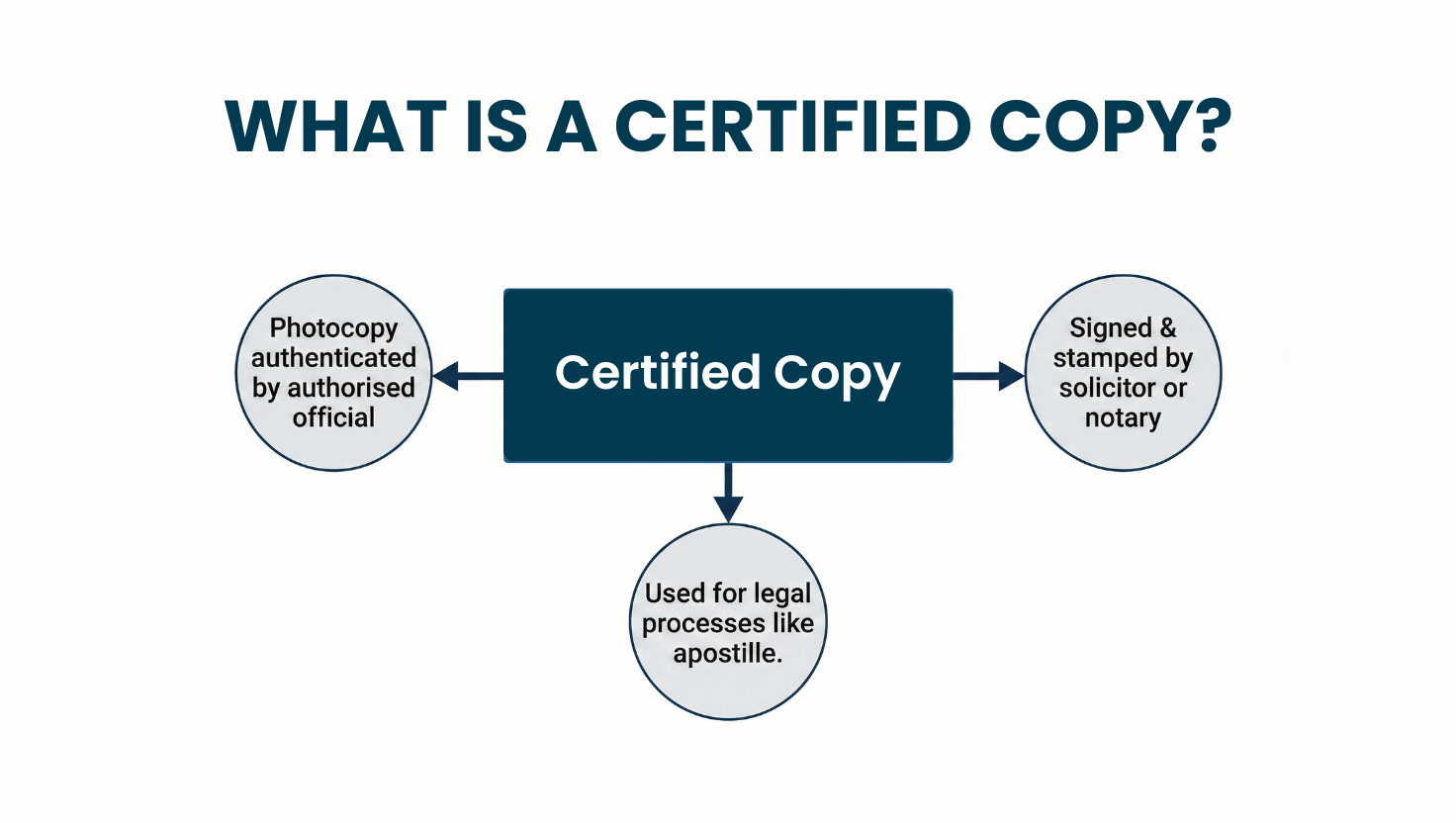
A certified document copy is a photocopy that has been authenticated by being signed and stamped by an authorised public official, like a solicitor or notary public.
Once a document has been certified, it can be ‘legalised’. This is the process of making a document legally acceptable in countries that are part of the Hague apostille convention.
The certification of a document doesn’t verify that the document is genuine.
When is a certified copy required?
Certified document copies are required for UK ID documents such as passports and driver’s licenses. In addition, certified copies are required for documents that can legally not be altered.
You may want a certified copy to preserve the original document, or if you can’t get a replacement document like a P60 form.
Most digitally issued documents require certification before they can be used for legalisation.
You’ll also need a certified copy of your documents if a copy has been requested from the overseas authority.
And specific business documents like – company board resolutions must be certified.
Types of document certifications
Document certification isn’t one-size-fits-all. The type you need depends on what you’re certifying and where it’s going.
If you’re moving abroad for work, getting married overseas, or applying for a visa, understanding which type applies to your situation saves time and avoids rejections.
Here are the main types:
How to certify documents
Documents are certified by including a written statement to that effect, which is then signed, stamped, and dated by a UK solicitor or relevant authority.
The certifier must include the following in the certified copy:
If your document has multiple pages, the certifying authority can write a certification on the first page and specify all the pages it relates to.
Additionally, they must securely attach all the related pages together to ensure that they are not tampered with.
Alternatively, the certifier can sign and stamp each page of the certified copy [2].
While certification does not confirm the document’s contents, it is a mandatory step for legalising some documents.
Wording for certifying documents
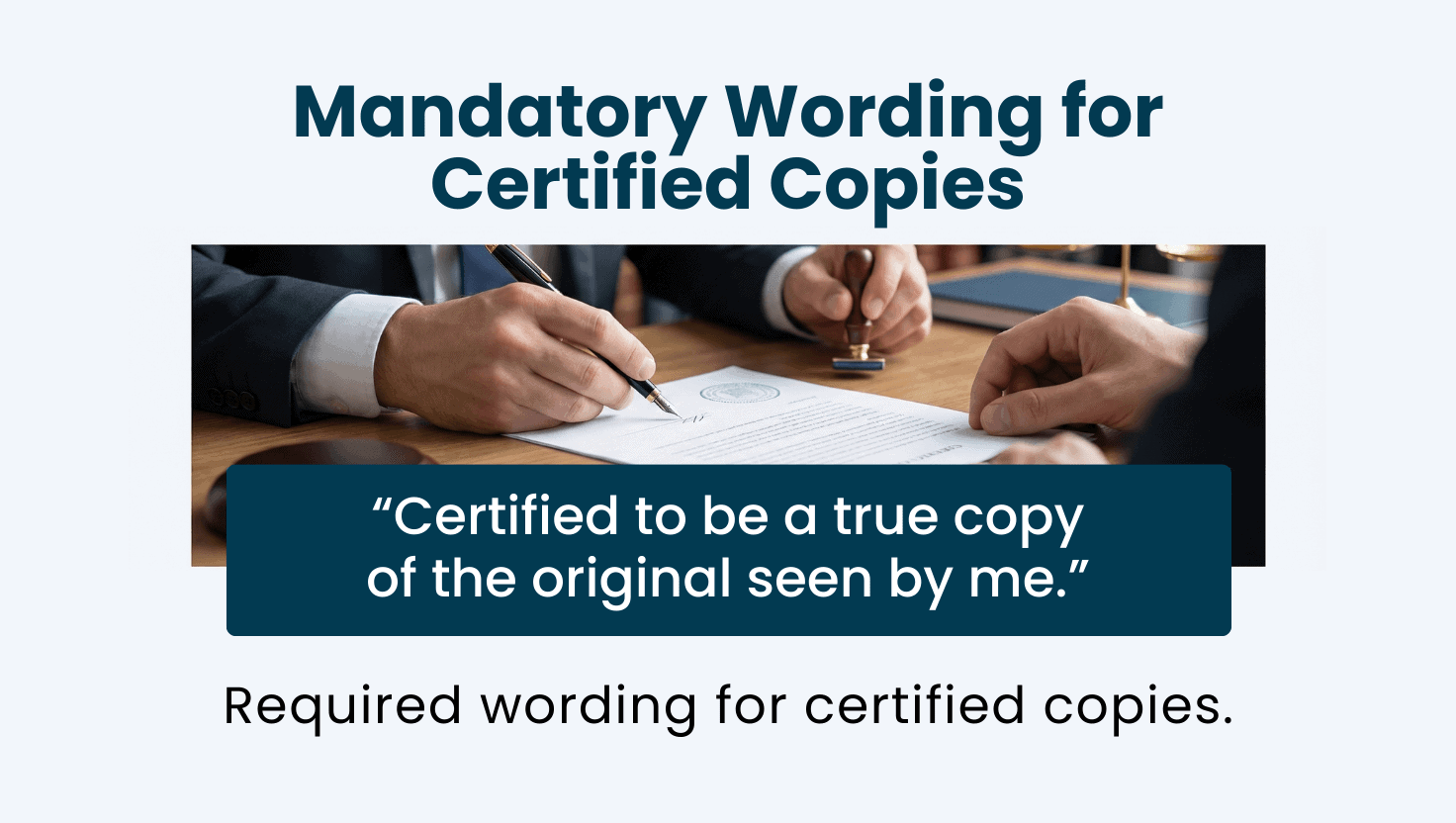
The format and wording are usually the standard government-suggested wording, or the following statement on the face of the document is generally acceptable:
‘I [insert full name of the authorised person] CERTIFY that this document is a true and complete copy of the original’
OR (in the case of a photographic ID)
‘I [insert full name of the authorised person] CERTIFY that this document is a true and complete copy of the original and a true likeness of the individual [insert name]’
The authorised person must sign the document and print their name, company, position, contact information and date the document was certified.
Sometimes, the requesting authority might ask for a different format – to make it acceptable in their country.
Conditions for document certification
Copies of documents can only be certified under the following conditions:
Who can certify documents for legalisation in the UK?
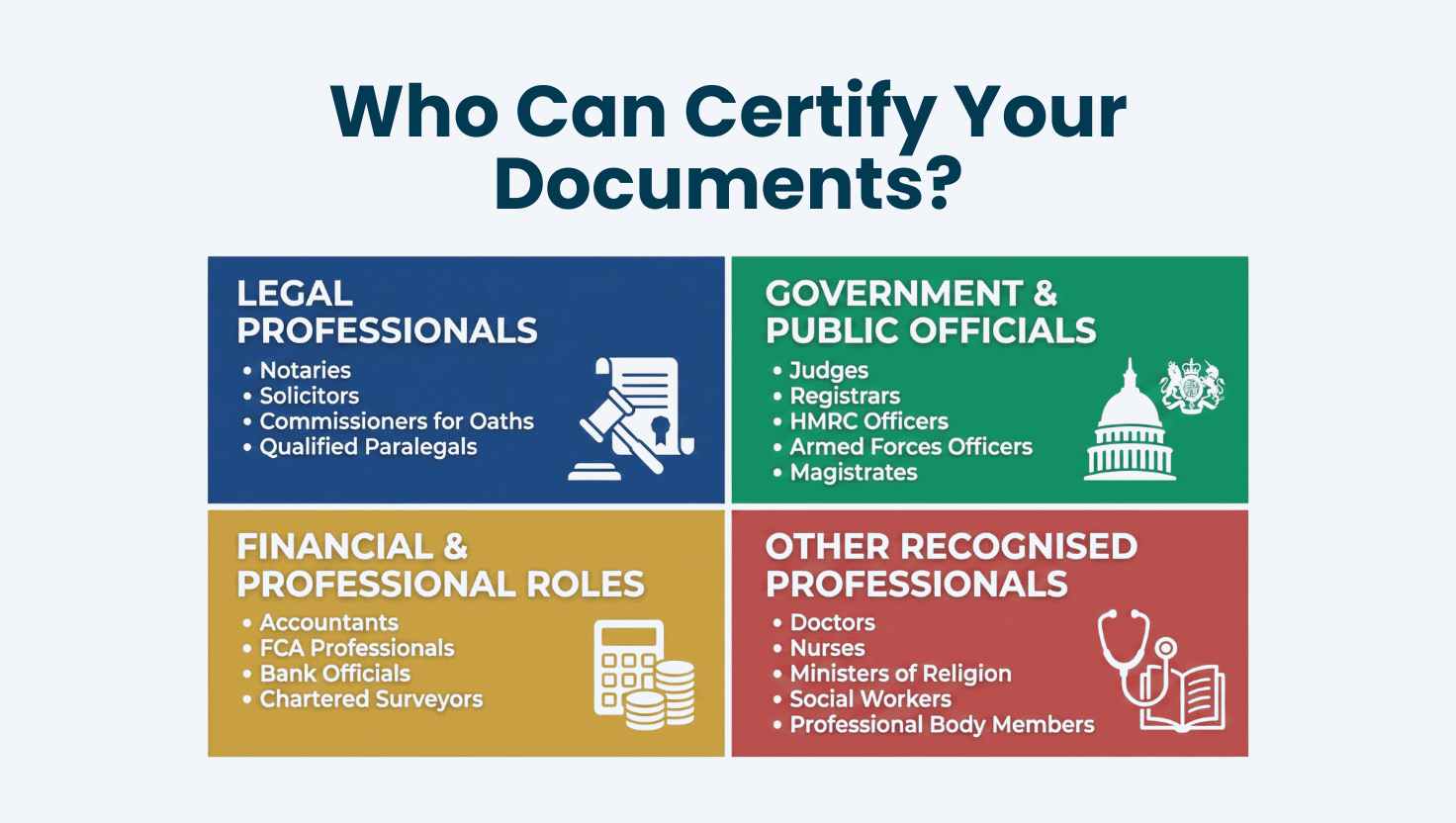
A typical list of acceptable third parties who can certify documents for legalisation in the UK includes notaries, solicitors, commissioners for oaths, and various professionals such as FCA professionals, accountants, chartered surveyors and magistrates [4].
If you are planning on using your documents outside the UK, certification by a notary public is the most ideal.
A notary certifies a document by attaching a notarial certificate with the certification or by including a signed declaration on the document photocopy.
All notarial certifications have a unique seal.
Other UK officials who can provide a certified copy of documents include:
*This list is not exhaustive
The individual certifying your documents must not be related to you, living with you or in a relationship with you.
Note: The organisation that needs the certified copy may have specific rules for who is permitted to certify documents, so check with them first.
Why certified copies get rejected (and how to prevent it)
Even properly certified documents can be rejected if they don’t meet specific requirements. One rejected document can delay your plans by weeks.
Common rejection reasons:
How to prevent rejection
Start by contacting the requesting organisation. Ask them three questions:
These answers prevent 90% of problems.
For international use, use an FCDO-registered notary public. Yes, it costs more, but notarial certification has the highest acceptance rate worldwide.
After getting certified, check that the certified copy includes:
For documents with several pages:
Also, make sure your photocopy is:
Never send your original documents by post if you can avoid it. Get them certified and send the certified copy instead, unless the requesting authority specifically requires the original.
If a document gets rejected, ask why. Often, it’s something simple like a missing date that you can quickly fix with recertification.
Use of certified copies internationally
If a certified photocopy of an original document is used internationally, it must comply with the destination country’s rules and laws.
The Hague Convention (Hague Apostille Convention) abolished some of the stricter rules, making accepting certified and apostilled documents more straightforward and more acceptable between member countries [5, 6].
For countries outside the Hague Convention (like Qatar, Egypt, and Kuwait), you may need additional embassy attestation after the apostille.
We can guide you through the specific requirements for your destination country and handle the full legalisation process, including apostille.
Get your documents certified and apostilled with London Apostille Services Ltd to make sure they’re accepted abroad.
How to certify a translation
To certify a translation, the translator or the certifying authority must stamp and initial each of its pages to prevent misuse or tampering.
In the UK, Qualified ITI members or Qualified Members employed by Corporate ITI members (Language Service providers) can endorse a translation by affixing ITI certification seals, which render the translation “official”.
In this case, you must obtain clear instructions about certification and the use of seals from the requesting organisation.
A notarial certification is recommended if you plan to use the translation overseas.
A translation can be notarised by either including a declaration from the translator, which is signed by a notary, or by attaching a notarial certificate confirming that the translated document is a true representation of the original.
Notarised translations are considered “official” for legalisation.
However, the notary’s signature does not confirm the translation’s quality unless they are a Qualified ITI member in the language of translation.
If you need a certified translation for use abroad, contact our team. We work with sworn translators in over 100 languages and can arrange notarisation and apostille services all in one place. Pricing starts from £40 per page only.
Frequently asked questions (FAQs)
Here are answers to some of the most common questions we receive about document certification.
Conclusion
Certification of documents is a vital process for legalisation and obtaining an apostille and can be completed by several trusted professionals.
However, it is always recommended that you confirm the requirements of the requesting organisation to see who they will accept the certification from.
Notarial certification is the highest level of certification and is ideal for documents to be used outside the UK.
Notaries specialise in certifications and will ensure that your documents are correctly certified.
You can always contact us for advice on getting your documents certified and ready for legalisation.


