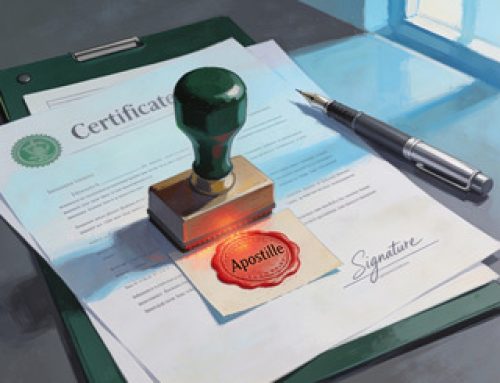
When relocating abroad, foreign authorities may ask you to present a certificate of good conduct.
This can be a confusing request, as the UK does not issue a document by that exact name. Instead, various police certificates and disclosure checks fulfil this requirement, depending on your destination and the requesting authority.
This post explains how to obtain the equivalent of a certificate of good conduct in the UK and how to legalise it for use abroad.
What is a Certificate of Good Conduct?
A certificate of good conduct is a document that the government issues to you confirming your criminal record (or lack of it).
Some foreign authorities requesting the document may also refer to it as a police clearance certificate, background check, or criminal record check.
The purpose of the request is to confirm that you won’t pose a security risk while working or residing within their jurisdiction.

Which UK document counts as a Certificate of Good Conduct?
The UK does not issue a specific document named ‘Certificate of Good Conduct.’ Instead, the ACRO Police Certificate, DBS Checks, and Disclosure Scotland/AccessNI serve the same purpose.
ACRO Police Certificate
The UK’s ACRO Criminal Records Office issues the ACRO Police Certificate, which provides a summary of your criminal record as captured by the UK National Police Computer (PNC).
These records include:
The certificate is designed for those travelling or relocating to other countries. Therefore, foreign authorities will likely accept your ACRO Police Certificate as a certificate of good conduct, especially if it is legalised for use overseas.
Specifically, in the UK:
Need help navigating the apostille process efficiently? Our firm, London Apostille Services Ltd., is an FCDO-registered apostille facilitator, and we can help you apostille your criminal records check in as little as 24 hours.
Request a custom quote telling us which police certificate you hold, and we’ll provide a full pricing breakdown of our expedited legalisation services.
DBS Checks
A Disclosure and Barring Service (DBS) check is a verification of your criminal records history, including convictions, reprimands, cautions, and warnings.
The main difference from the ACRO Police Certificate is that it is designed for domestic use.
Therefore, it is rarely the correct choice when relocating abroad. Unless the requesting foreign entity specifically asks for a DBS check, it makes more sense to apply for an ACRO Police Certificate.
Disclosure Scotland or AccessNI
Because of distinct legal systems, DBS only operates in England and Wales. If you’re in Scotland or Northern Ireland, you can apply for a check through your local agency as follows:
Again, if you intend to use the document abroad and the requesting authority hasn’t specifically requested the above Scottish and NI checks, it is best to get an ACRO Police Certificate.
When do you need a UK Certificate of Good Conduct?
Foreign authorities and employers typically require a certificate of good conduct in the following circumstances:
Also, while it is less common, you may be asked to produce such a certificate when applying to study abroad.
How to get a Certificate of Good Conduct in the UK
Getting a criminal records check in the UK is relatively straightforward because the agencies involved have standardised their processes.
Here’s a step-by-step guide to get you started:
Most foreign authorities require a paper-based certificate of good conduct. Luckily, even if you apply online, ACRO/DBS will send you a physical copy via post.
The legalisation roadmap: Making it valid abroad
The certificate issued by the UK agencies is strictly a UK document. To make it valid for overseas use, you must legalise it for that purpose.
Under the Hague Apostille Convention, the legalisation process involves obtaining an apostille, an internationally recognised certificate that confirms that your document is genuine.
You can get the apostille by independently submitting your criminal records document to the FCDO for legalisation. However, there are two important points to remember:
London Apostille Services Ltd. is an FCDO-registered apostille facilitator, and you can leverage our fast-track services to get your apostille in 24 hours (Express Service) or 3-4 days (Standard Service).
Request a custom quotation for a full breakdown of our pricing, covering the turnaround and legalisation options you need.

Frequently asked questions (FAQs)
Here are answers to some of the commonly asked questions about getting a certificate of good conduct in the UK.