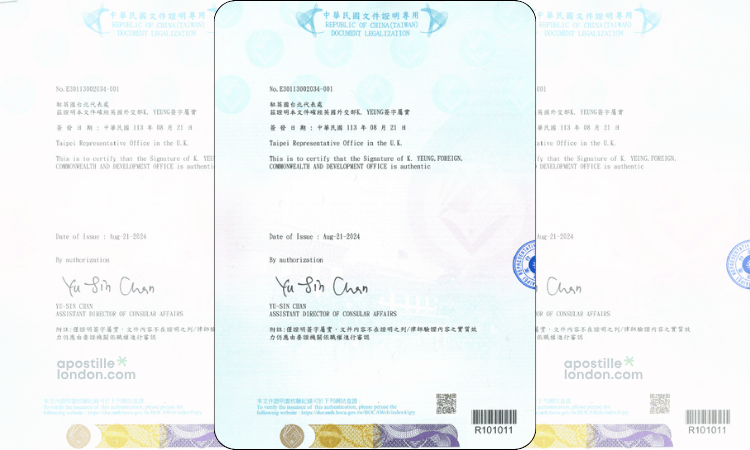
To use a UK document in Taiwan, you must legalise it through the Taipei Representative Office (TRO) in London or Edinburgh.
To legalise a UK document for use in Taiwan, follow these steps:
Before submitting your documents, ensure you have the following:
- 1
Original document: This is needed for comparison and verification.
- 2
Photocopy of the document: This will be submitted to the Consulate.
- 3
Application form: Fully completed and signed by the applicant. (
link)
- 4
Letter of authorisation: Fully completed and signed by the applicant. (link)
- 5
Copies of passports: Clear copies of both the applicant’s and the agent’s passports.
- 6
Company’s Certificate of Incorporation (if applicable): A copy of this certificate is required if the application is related to a company.
Taipei Representative Office (TRO) legalisation costs:
| Legalisation service (per document) | Cost | Processing time |
| Personal document: verification, solicitor certification and apostille certificate | £120 | 6-7 working days |
| Taiwan Embassy attestation service | £55 | |
| | |
| Personal document: verification, notary certification and apostille certificate | £210 | 6-7 working days |
| Taiwan Embassy attestation service | £55 | |
| | |
| Business document + verification + notarisation + apostille service | £245 | 6-7 working days |
| Taiwan Embassy attestation service | £55 | |
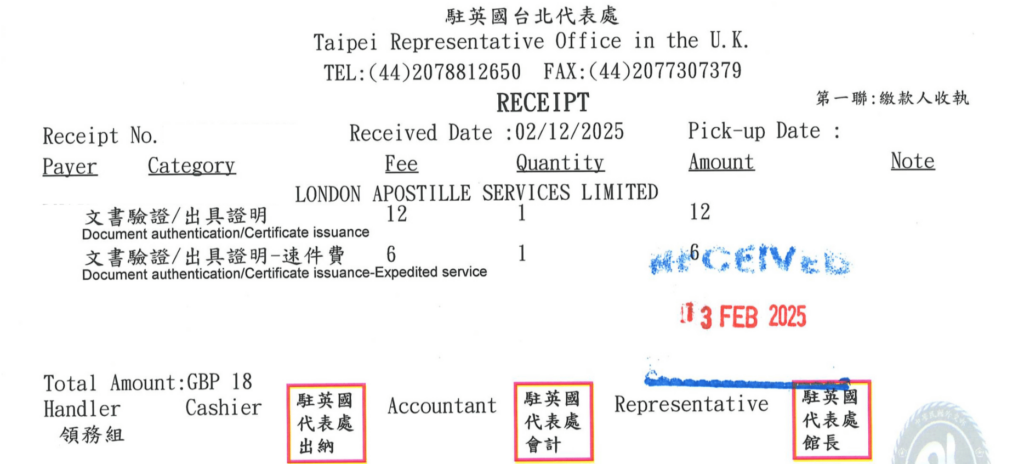
Receipt from the Taipei Representative Office in the UK
Notarisation and certification:
Different documents require different levels of certification:
Personal documents (e.g., school letters, educational certificates): A UK FCDO-registered notary public must certify these documents. The notary must confirm they have verified the document’s authenticity with the issuing institution.
Documents eligible for FCDO Apostille (e.g., UK Birth, Marriage, Death certificates): A notary public cannot certify these documents. You must obtain an Apostille from the FCDO, which verifies the signature of the UK public official on the document. A birth certificate must carry both parents’ names on the document.
Other documents: An FCDO-registered solicitor or notary public must certify a copy of the document. They must verify the document’s authenticity and content with the issuing authority and include a statement confirming this verification. Statements like “true copy of the original” are not sufficient.
Certification example:
I certify that his document has been verified and authenticated as a true copy of the genuine electronic document issued by . [FCDO-registered solicitors signature]
Certified translations:
Taiwan’s official language is Mandarin Chinese. You’ll likely need a certified translation if your documents aren’t in Mandarin.
English documents: While English is often accepted, it’s best to check with the relevant Taiwanese authority to confirm whether a Mandarin translation is necessary.
Translations done outside Taiwan: These must be legalised separately, just like your original document. This ensures both are officially recognised in Taiwan.
Determine the correct Taipei representative office:
Taipei representative office in London: This office handles documents issued in England, Wales, Northern Ireland, the British Overseas Territories, Crown Dependencies (excluding the Isle of Man), Ghana, the Seychelles, and Sierra Leone.
London Office
Address: 50 Grosvenor Gardens, London SW1W 0EB
Telephone: +44 (0)20 7881 2650
Opening hours: Monday to Friday: 09:30-12:30.
Taipei representative office in Edinburgh: This office handles documents issued in Scotland, Cumbria, areas north of Durham, and the Isle of Man.
Edinburgh Office
Address: 1 Melville Street, Edinburgh EH3 7PE
Telephone: 0131 220 6890
Opening hours: Monday to Friday: 09:30-12:30.
No appointment is necessary for submissions made through a UK agent.
Accepted methods of payment for agencies are cash only.
This guide provides a general overview of the legalisation process.
As an experienced legalisation agency, we can take care of the entire process for you.
Need help?
 Skip to content

 All UK-origin documents bound for Taiwan must first be apostilled by the UK FCDO and then lodged with the Taipei Representative Office (TRO) in London (or Edinburgh for files linked to Scotland, Cumbria, Durham northwards, and the Isle of Man) for a second, mandatory authentication stamp.