

 Angola is not party to the 1961 Hague Apostille Convention, so every UK document must pass through two UK stages before it will be accepted by Angolan authorities:
- UK FCDO apostille (after solicitor/notary certification where required)
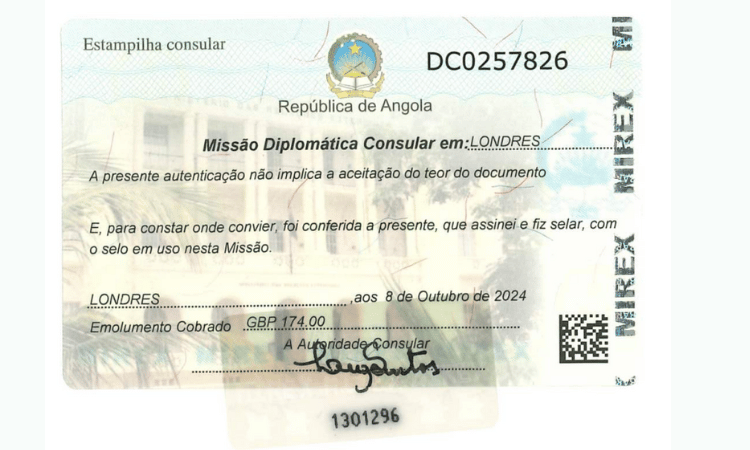
- Consular legalisation at the Consulate General of Angola in London
We are an FCDO-registered agent and make daily visits to the UK’s Apostille Office in Milton Keynes (Hanslope Park) to lodge and collect documents on behalf of our clients.
We’ll also handle the Angola consular legalisation in London for you, end-to-end, once the apostille is complete.
To legalise a document for use in Angola, you’ll need to:
Documents must be translated into Portuguese, with the translated version placed before the original English version in the document bundle. Translations of UK documents require a certified translator based in the UK.
Any notarial certification must be in Portuguese and English. If it is in English only, a Portuguese translation must be attached to the front of the apostilled document.
How to present the apostilled document to the consulate:
- 1
First page: Bilingual notarial coversheet confirming the document’s authenticity.
- 2
Second page: Portuguese translation of the original UK document
- 3
Third page: The apostilled UK document (documents must be originals)
- 4
Fourth page: The BILINGUAL Portuguese translation certificate
- Document bundles are not allowed.
- A photocopy of the document is required for submissions.
- Submissions require a request letter.
Educational Documents
To avoid delays, please submit both your original document AND the apostilled copy when requesting authentication. This allows the embassy to compare the documents and verify their authenticity.
For the legalisation of private documents, please provide a copy of the applicant’s passport, residential address, contact number, email address, and parent’s names.
We require a copy of the director’s passport, the company’s registered address, contact number, and email address for commercial document legalisation.
Company Powers of Attorney
To submit a Company Power of Attorney, please include:
- Certificate of Incorporation
- Board Resolution
- Covering Letter for the Embassy (outlining the purpose of the legalisation)
Important: If any pages in your document are blank, draw a line through them and indicate they are intentionally left blank.
We may also request additional supporting documentation, such as a Memorandum & Articles of Association.
For documents issued by foreign companies, the Certificate of Incorporation must be certified by the respective diplomatic body of the company’s country of origin and translated into Portuguese.
Foreign companies are also required to have the Memorandum and Articles of Association, but only an English translation is necessary.


Need assistance?
If you find the legalisation process overwhelming or time-consuming, consider seeking assistance from a professional document legalisation service like us. We can handle the entire process on your behalf, ensuring accuracy, efficiency, and peace of mind.
Included in our embassy attestation service:
Notice:
Please note that legalisation processing times can be affected by UK public holidays, occasional technical issues at the FCDO, or unexpected consulate closures. Additionally, fees may be subject to change without notice.
We are committed to informing you of any delays or additional costs that may arise during your application.
Our goal is to minimise disruptions and ensure a smooth legalisation process.