
Whether you are proving your identity to a local bank or submitting papers to an overseas institution, the person you choose to certify the documents can be the difference between them being accepted or flatly rejected.
Therefore, you must pay attention to the rules regarding who can certify documents in the UK for both local and international use.
This post will help you navigate these rules, explaining what certification actually means and breaking down the authorised professionals who can certify or notarise various types of documents.
TL;DR – Who can legally certify documents in the UK?
In the UK, depending on the type of document and the requesting institution, the following professionals can legally certify documents:
Certifications by solicitors and notaries public are widely accepted, while the rest have a limited scope and are rarely accepted abroad.
What does it mean to certify a document?
Document certification refers to the act of an authorised professional, such as a solicitor or notary, confirming that a document is authentic. It can be done in two ways:
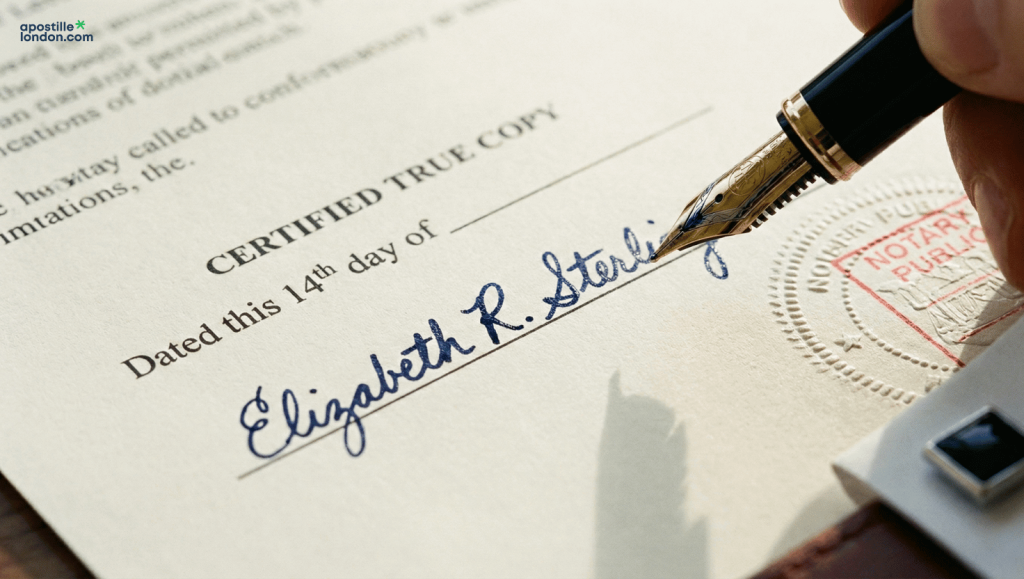
Usually, the person certifying the document will use specific wording. For a copy, they might write: “certified to be a true copy of the original seen by me.” For an original document, they may state: “I confirm this to be a genuine document” or “Signed in my presence.”
They’ll also sign and date the certification, print their name, and provide their occupation, address, and contact details.
It is vital to remember that document certification is not the same as:
The two are separate formal processes that may require a document to be certified before they can be finalised/issued.
Professionals who can certify documents
When documents are for domestic use, and the process is not strictly legal, you can have the following professionals certify your documents:
However, if it is a legal process, the bar for certification is higher. In that case, you must use either a solicitor or a notary public.
Who can certify documents for use abroad?
To ensure overseas institutions accept your documents, you should legalise them for international use. Document legalisation requires getting an apostille certificate, which is issued by the Foreign, Commonwealth and Development Office (FCDO).
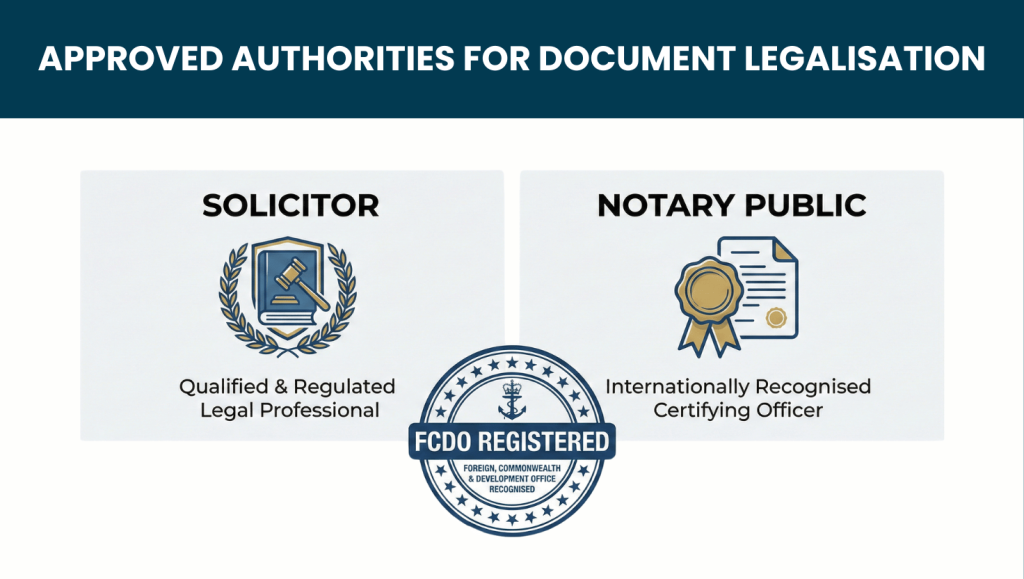
Private documents and copies of the original intended for an apostille must first be certified. Specifically, the FCDO requires you to use a solicitor or a notary public whose signature is in their database.
Therefore, for use abroad, you should get your documents certified by an FCDO-registered solicitor or notary public.
Notaries vs. solicitors – what’s the difference?
Solicitors and notaries are both legal professionals, but they have different primary functions:
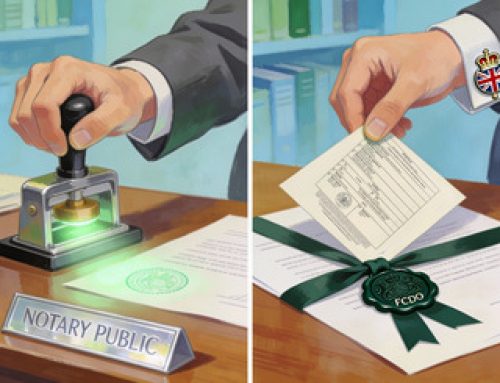
Specifically, here are the key differences to keep in mind:
That said, where a document is certified by a solicitor, and their signature and stamp receive the FCDO’s approval through an apostille certificate, the document will generally be recognised abroad if the destination country is a party to the Hague Apostille Convention.
Who cannot certify your documents?
People falling in the following categories cannot certify your documents:
Besides preventing a lack of professional accountability, these rules exist to avoid conflicts of interest. Therefore, any person who has a personal interest or financial stake in the document is disqualified from certifying it.
Moreover, professional status cannot override personal ties. In other words, even if your parent or business partner is a registered and licensed solicitor, they cannot certify your documents.
How to get your documents certified
You want to get your document certified correctly the first time to avoid rejections and delays. Here’s how to go about the process:
If you intend to use the document abroad, you must also get it apostilled by the FCDO. Further, if the destination country is not party to the Hague Apostille Convention, you’ll need embassy attestation in addition to the FCDO apostille.
The FCDO has registered apostille agents/facilitators to help you process apostilles. Our company, London Apostille Services Ltd., is one such registered apostille facilitator.
We do more than facilitate apostilles, though. Here’s what you get when you work with us:
Contact us today to start the process of legalising your documents for use abroad. If we receive your documents by 9 AM, they will be apostilled by the next working day.
PRO TIP: If your document is a UK government-issued original (such as a birth or marriage certificate), it won’t require prior solicitor certification. The FCDO can independently verify its authenticity, and we’ll just submit it as is for an apostille.
Frequently asked questions (FAQs)
Here are answers to some of the commonly asked questions about who can legally certify documents in the UK: