

Proving your identity is a necessity for various everyday life scenarios, from job applications to opening bank accounts.
In the United Kingdom, such identity checks aren’t just a formality. They are required by law, including money laundering regulations. As such, the forms of ID accepted by UK institutions are highly contextual.
In this post, we’ll explore the various forms of identity verification that are applicable in the UK. We’ll also discuss how to prepare your ID documents for use abroad.
TL;DR – Acceptable forms of ID in the UK
Here’s a quick overview of the generally acceptable forms of ID in the UK:
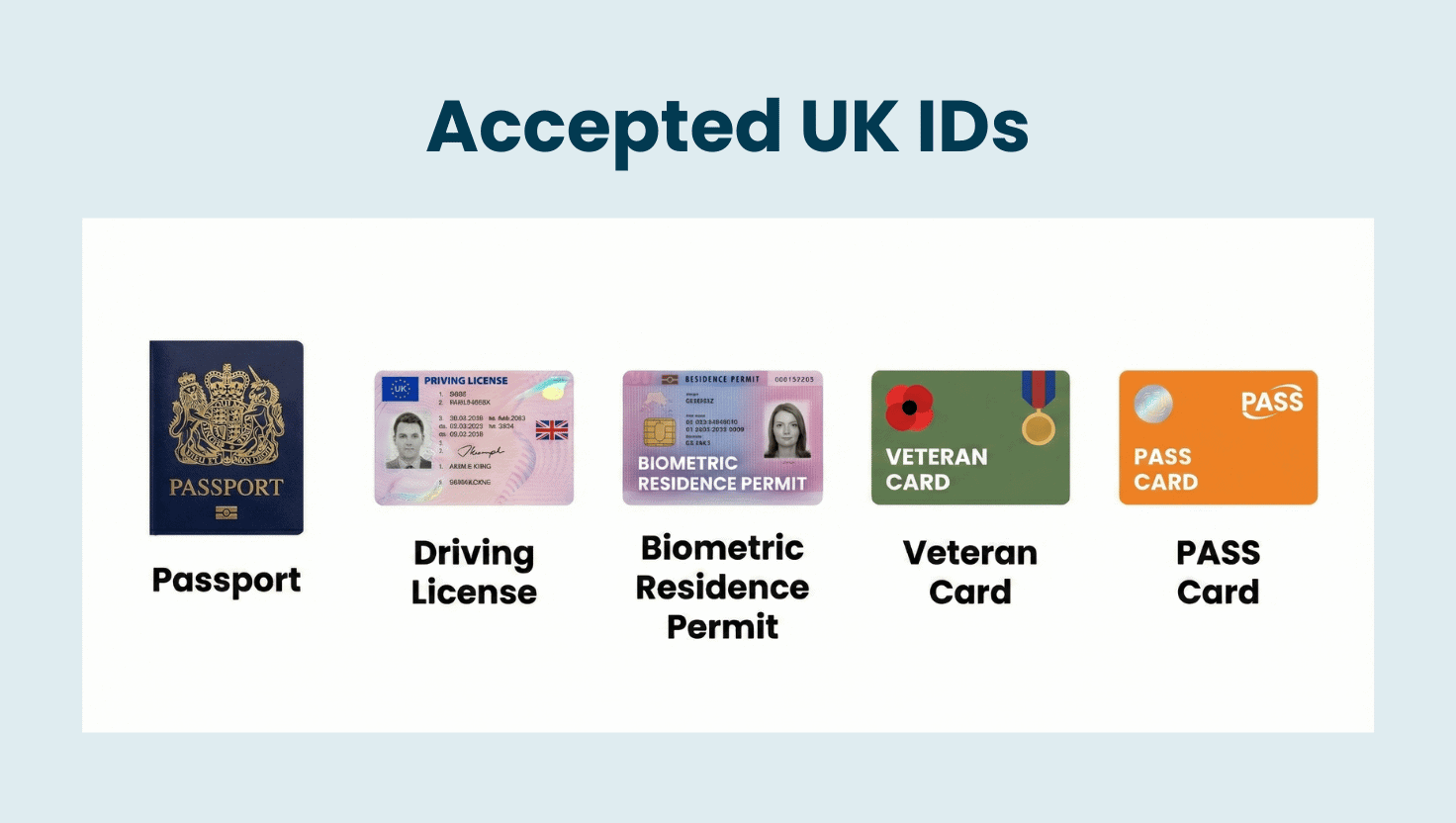
Common scenarios requiring proof of identity
In the United Kingdom, you’ll typically have to produce valid forms of ID in the following common situations:
What are valid forms of ID in the UK?
UK institutions often distinguish between various forms of identification, categorising them as primary and secondary (or alternative) forms of ID.
The distinction is often based on the issuing authority, as well as the reliability and universality of the documents.
Primary forms of ID
Primary forms of ID are government-issued identity documents that prove both identity and nationality or residency. Such a document will typically have your signature and photo.
They include:
Secondary and alternative forms of ID
Secondary forms of ID are often accepted in low-risk or low-security scenarios. Institutions may also request them, along with the primary forms of ID, as accompanying evidence.
Secondary forms of ID include:
Requirements for a valid ID document
Criteria for validity will depend on the institution requesting the ID. However, you can generally expect an ID document to be valid in the UK if it meets the following parameters:
You should also account for validity outside the United Kingdom. For official purposes, an overseas authority will likely only accept your ID as valid if the document has been legalised for international use.
Contact our team today to initiate the ID document legalisation process. We’ll help you meet all the country-specific legalisation requirements of your destination.
When a notary must verify your ID
A notary public is an internationally recognised legal professional authorised to deal with non-contentious legal matters.
An overseas institution may request a certified copy of your ID. Such a request is typically required for medium- to high-security transactions, such as setting up an international bank account or purchasing property abroad.
In that case, you’ll need the services of a notary public to verify your identity and the authenticity of the signatures/stamps on the ID document.
The process will include the notary public receiving the original ID document, making a copy, and affixing their signature and stamp on the copy.

Legalising your ID for international recognition
Getting the public notary’s stamp and signature is a good step in getting your ID documents recognised abroad, but it isn’t enough. You must also legalise the documents for international use.
The legalisation ensures your documents carry the same weight internationally as they do in the UK. It involves getting a certificate, known as an apostille certificate, from the Foreign, Commonwealth and Development Office (FCDO).
There are two points to remember when you want to get your ID documents apostilled:
- 1
The FCDO will authenticate the seal/signature of the notary public (or solicitor), not the contents of the document.
- 2
The FCDO has registered apostille agents/facilitators to help you navigate government bureaucracy and obtain apostille certificates more efficiently.
We are London Apostille Services Ltd, a FCDO-registered apostille facilitator with over 15 years of experience. We can help you legalise various forms of ID, including apostilles for photo ID cards, UK armed forces ID cards, and more.

Why your documents may not pass legal checks
Let’s explore the common pitfalls that may cause your documents not to pass legal checks:
- 1
Mismatch of address: Where the address on one document doesn’t match the one on another. In this case, you’ll need to provide supporting documentation to explain the discrepancy.
- 2
Uncertified copies: Many institutions will reject uncertified printouts. Consider getting copies certified by either a solicitor or a notary public.
- 3
Missing signatures or stamps: If the signature or stamp of the solicitor/notary is missing, the document may not pass legal checks. Ensure both are present.
- 4
Suspicion of alteration: If there’s extensive wear, damage, or lamination, the institution may suspect an effort to conceal an alteration. If this applies to you, get a new, clean, and certified copy.
- 5
Unlegalised documents: For official use, international institutions will likely reject documents that haven’t been apostilled.
Also, even if you obtain an apostille certificate, a rejection may still occur if you present it without an embassy attestation in a country that is not a party to the Hague Apostille Convention.
Therefore, if you intend to use your document in a country such as Angola, Nigeria, Qatar, Saudi Arabia, or the UAE, we’ll help you obtain an embassy attestation in addition to the FCDO-issued apostille.
Contact us today to get your identity documents ready for use abroad. We offer expedited services, completing the apostille process in one business day with our next-day service, or three to four business days with our standard service.

Frequently asked questions (FAQs)
Here are answers to some of the common questions about acceptable forms of ID in the UK:


