

Witnessing rules are central to the proper execution of legal documents. Often, the validity of a legal document depends entirely on the witness being qualified.
Therefore, you must seriously consider the decision on who can witness a signature on a legal document because the rules vary by document type and the governing legislation. For instance, general Powers of Attorney and Lasting Powers of Attorney are governed by the Powers of Attorney Act 1971 and the Mental Capacity Act 2005, respectively.
In this post, we’ll explore who can witness various UK documents, including wills, powers of attorney, deeds, and affidavits.
The evidentiary role of a witness signature
Witnessing rules are primarily a legal safeguard to prevent fraud and undue influence.
Often, when one witnesses a signature on a legal document, they are attesting to the following facts:
Additionally, in furtherance of their evidentiary role, the witness’s signature confirms their willingness to testify about the circumstances surrounding the signing if the document is challenged in court.
Who can witness a signature on a legal document?
Generally, the following standards must be met for one to be a competent witness:
In most formal cases, it’s a requirement that the witnessing be a physical act. The witness must be physically present in the room to observe and assess the circumstances surrounding the signing.
Further, if you intend to use the document internationally, it is best to have a notary public or solicitor witness the signatures. Even then, you must legalise the document for use abroad by submitting it to the Foreign, Commonwealth and Development Office (FCDO).
Contact us to use the reliable notaries/solicitors within our network and for help managing the FCDO legalisation process.
Document-specific witnessing rules
Each legal document operates under its own statutory framework. As such, you must pay attention to document-specific witnessing rules.
Below are the rules for powers of attorney, deeds, wills, and affidavits:

Witnessing rules for powers of attorney
Ordinary powers of attorney (OPA) are governed by the Powers of Attorney Act 1971, which sets the following witnessing rules:
Lasting powers of attorney (LPA) are governed by the Mental Capacity Act 2005, which sets the following witnessing rules:
For LPAs, the law establishes the role of a certificate provider, whose responsibility is to ascertain the voluntariness and mental capacity of the donor.
Notably, the certificate provider is not a witness. They sign a different section of the LPA form.
Witnessing rules for deeds
Witnessing rules for deeds are governed by the Law of Property (Miscellaneous Provisions) Act 1989 and the Companies Act 2006. The requirements are as follows:
While the law does not expressly forbid beneficiaries and family members from witnessing deeds, the industry best practice is to avoid using them as witnesses. It’s best to get a completely independent party.
Witnessing rules for wills
The witnessing rules for wills are governed by the Wills Act 1837. The requirements are as follows:
Witnessing rules for affidavits
In the case of an affidavit, the witness must not only be an independent person, but they must also be authorised by law to administer oaths.
Therefore, the role of the witness is reserved for Commissioners for Oaths, who can be:
The witnessing must be a physical act. The deponent must sign the affidavit in the presence of the Commissioner for Oaths.
The Commissioner for Oaths must also verify the identity of the deponent and complete the Jurat to confirm where, when, and before whom the affidavit was signed and sworn.

Who cannot witness a legal document signature
From the foregoing, it’s evident that UK rules for witnessing legal documents are based on capacity and impartiality.
Therefore, the following persons cannot witness signatures on a legal document:
When a signature requires a solicitor, notary, or other professional
For high-stakes documents, witnessing goes beyond attestation by an independent adult to include certification by Commissioners for Oaths.
The document types where the law mandates an authorised professional to act as a witness include:
The law does not mandate a solicitor/notary to witness wills, deeds, or lasting powers of attorney.
However, due to the stakes involved, best practice demands that you use a solicitor/notary to create a strong layer of defense in case the document is challenged in court.
How to find an authorised person to witness your document
In the case of documents for foreign jurisdictions, it is not enough that an authorised person (e.g., a solicitor or notary public) witnesses the signatures on the legal document.
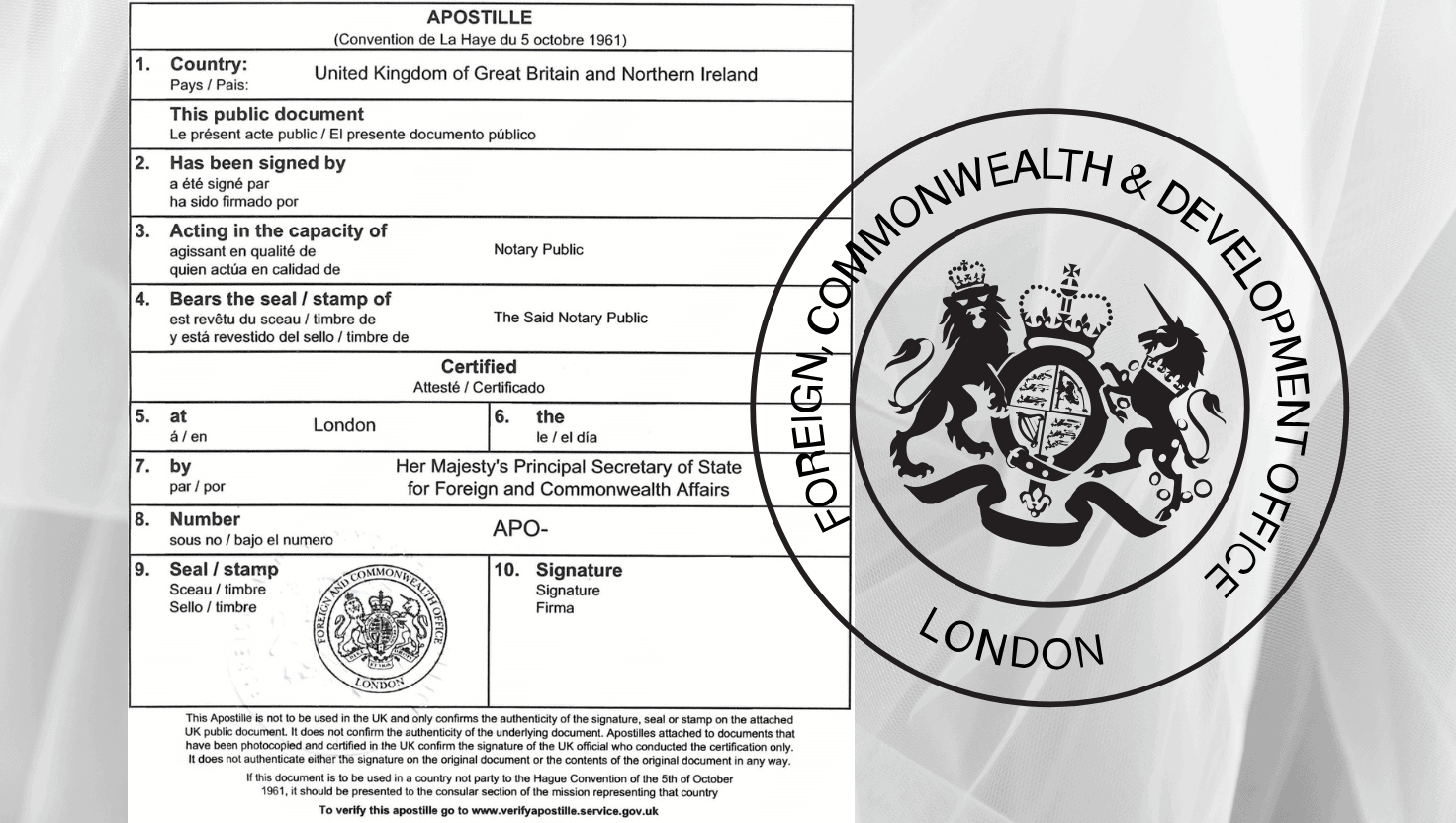
You must also submit your documents to the FCDO to get a certificate confirming that the signatures and stamps of the solicitor/notary are genuine.
The certificate is called an apostille certificate, and it legalises your document for use outside the UK.
At London Apostille Services Ltd., we can help you navigate this crucial step by:
- 1
Connecting you with an FCDO-recognised notary public or solicitor in London to ensure your document is witnessed and certified correctly.
- 2
Managing the FCDO legalisation process on your behalf, saving you the need to navigate complex government bureaucracy on your own.
Suppose your destination is a country that is not a party to the Hague Apostille Convention, such as the UAE, Qatar, or Nigeria. In that case, you will need embassy attestation in addition to the FCDO-issued apostille. We can also help with this step.
Contact us today to get your affidavit, will, deed, power of attorney, or any other legal document ready for use abroad. We offer expedited services and can complete the full legalisation in one business day with our next-day apostille service.
Frequently asked questions (FAQs)
Here are answers to some of the commonly asked questions about who can witness a signature on a legal document:


