

A lasting power of attorney (LPA) allows you (the donor) to appoint one or more people (the attorney) to make decisions on your behalf if you lose mental capacity.
Because the document grants the attorney significant powers over your affairs, the law establishes various safeguards to protect against abuse and undue influence, including requiring a certificate provider to complete and sign an LPA certificate.
In this post, we’ll discuss the components of an LPA certificate and the responsibilities of a certificate provider.
What is the ‘LPA certificate’?
An LPA certificate is a section within the LPA form that the certificate provider completes and signs during the LPA creation process.
The certificate provider is an independent individual whose primary role is to protect the donor by ascertaining that the donor understands what they’re doing and that they are not being pressured.
The Mental Capacity Act 2005 mandates completing an LPA certificate. Without the certificate, the Office of the Public Guardian will not register an LPA, rendering the document invalid.

Key declarations within the LPA certificate
The declarations within the LPA certificate capture the core responsibilities of the certificate provider.
The certificate provider’s signature attests to the following facts:
The three declarations confirm the donor’s capacity to enter the legal arrangement.
Who can be a certificate provider for LPA?
Given the certificate provider’s vital role in the LPA creation process, the law has strict guidelines on who can and cannot act as one.
A certificate provider must be an independent adult qualified to fulfill the role. Generally, you can choose a certificate provider by taking either of these two routes:
It’s best to choose a professional over a layperson. A professional will likely have established processes and will produce documentation that will be useful if the LPA’s validity is challenged in court.
Who cannot be a certificate provider for an LPA?
Because impartiality is central to the certificate provider’s role, the law disqualifies the following from being a certificate provider for an LPA:
The LPA certification process
The certificate provider completes and signs the certificate portion of the LPA. The process will typically unfold as follows:
The donor and the certificate provider must sign the LPA certificate to complete the certification process. The signing order is essential, and is as follows:
Notably, where a professional is contracted to act as a certificate provider, the process will likely include taking and keeping detailed notes and records to show the steps taken to satisfy the requirements for understanding and undue influence.

Reasons an LPA certificate might be invalid
Various failures and errors can render the LPA certificate invalid. The common causes of such invalidity include:
- 1
Disqualification of the certificate provider: It applies when the certificate provider was ineligible to act as one, e.g., a family member of the attorney or an employee of a care home the donor lives in.
- 2
Presence of procedural errors: Common errors include an incorrect signing order and missing signatures. Additionally, failure to properly (and actively) assess for mental capacity and undue influence will render the certificate invalid.
- 3
The certificate provider did not understand their role: The certificate provider has a different role from that of a witness. The LPA certificate is invalid when the certificate provider treats their responsibility as if it were a simple witnessing role.
The certificate provider’s decision isn’t set in stone. It can be successfully challenged.
Despite the certificate provider attesting to the donor’s mental capacity and lack of undue influence, the Court of Protection may determine that that wasn’t the case at the time of signing and set the LPA aside. Therefore, all required procedures must be strictly followed.
Pro tip: Even if properly executed as per the law, your lasting power of attorney is a UK document and may be invalid in some jurisdictions abroad.
To ensure validity overseas, you must have your LPA notarised and apostilled.
- 1
Notarisation is done by a notary public, an internationally recognised public official who validates the authenticity of documents.
- 2
An apostille is issued by the Foreign, Commonwealth and Development Office (FCDO), and it will validate that the signature of the notary public on the LPA is genuine.
The FCDO has registered apostille agents and facilitators to help you process your apostille fast.
We are London Apostille Services Ltd, a duly registered apostille facilitator with over 15+ years of experience. We can manage the entire apostille process on your behalf, completing it fast with our next-day apostille process.
Moreover, we have reliable public notaries in our network, ensuring you can get your LPA notarised and apostilled without having to coordinate several professionals.
Contact us today to get your LPA ready for use abroad. If we get your document by 9 AM, it will be ready by the next working day.
Consequences of an invalid LPA certificate
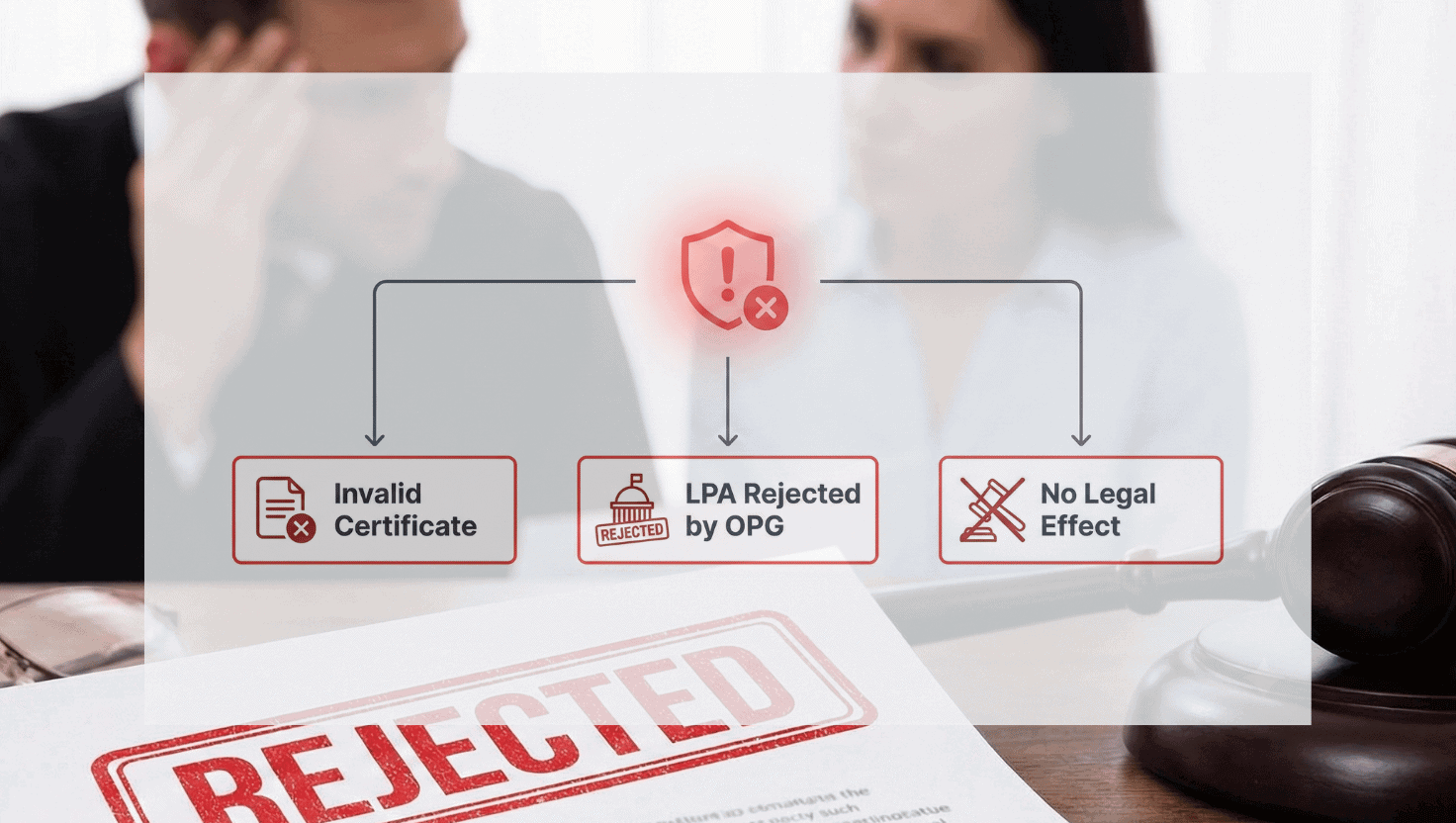
When an LPA certificate is invalid, it affects the entire LPA, making the document ineligible for registration by the Office of the Public Guardian. Consequently, the document has no legal effect.
Such a rejection by the Office of the Public Guardian will result in:
Unlike the attorney chosen by the donor, who has relative independence, the deputy is subject to strict and ongoing supervision by the Court of Protection and the Office of the Public Guardian.
Frequently asked questions (FAQs)
Here are answers to some of the commonly asked questions.


