Formal procedures involving institutions like banks, academic bodies, and immigration departments may require you to produce a letter of attestation.

While such a request may come unexpectedly or on short notice, you need not panic. There are established processes you can follow to get the document relatively quickly.

This post explores what a letter of attestation is, how to get it, and how to prepare it for use abroad.
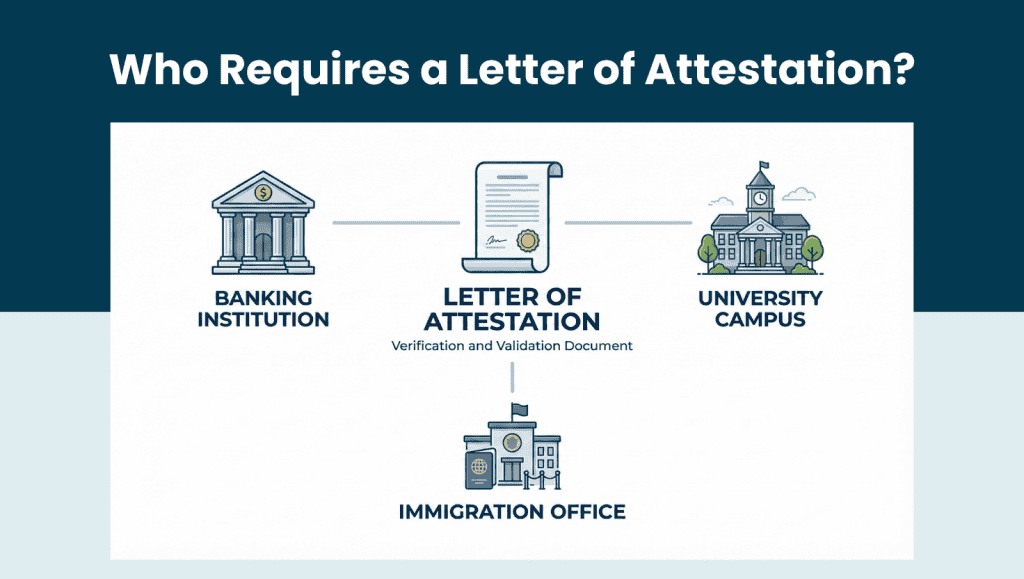
Institutions that require a letter of attestation such as banks universities and immigration offices

What is a letter of attestation?

A letter of attestation is a formally written statement that certifies the authenticity of a claim, event, or document.

Here are examples of the things such a letter may attest to:

  • Identity

  • Address

  • Relationship status

  • Employment history

  • Academic credentials

  • Authenticity of documents

The attestation must be done by a qualified third party. Think of it as a certified testimonial to give the requesting institution the confidence to trust the information you’ve provided.

Close-up of a golden wax seal stamped on a document to represent the authenticity and formal certification of a letter of attestation.

Types of attestation letters in the UK

The types of attestation you’ll need depend on the information the requesting institution wants to verify.

Generally, you can get the following attestation letters in the UK:

  • Professional standing attestation: It’s a formal verification issued by a regulatory body (such as the General Medical Council (GMC) for doctors) confirming that you’re in good standing and meet all current professional requirements.

  • Identity or address attestation: Applies when you need to prove your identity or address. It’s often requested to comply with banking, Anti-Money Laundering (AML), and immigration regulations.

  • Employment attestation: Applies when you need to prove previous job titles/descriptions, salaries, or dates of service. It’s often requested when applying for work permits or employment-related visas.

  • Academic attestation: It proves that your degree or educational certificate is genuine. You’ll get it from the primary source of the document (school/university) and/or the relevant government body.

  • Medical attestation: You’ll need it to prove your health status or vaccination record.

Who can issue a letter of attestation?

In the UK, you can get a letter of attestation from chartered professionals, legal professionals, industry regulators, or the institution that’s the primary source of the document being verified:

  • The primary source of the document: Applies when you leverage the original issuer of the document to confirm its authenticity. For instance, a university registrar attesting to a degree certificate or a company HR manager attesting to an employment record.

  • Chartered professionals: Where the verification lies within their area of competence, professionals like accountants and doctors can issue a letter of attestation.

  • Legal professionals: Solicitors and public notaries can attest to a declaration, the fairness of a process, or that a copy of a document is a “true copy” of the original.

  • Industry regulators: Professional bodies can attest to professional status, corporate status, or registration. Such bodies include the General Dental Council (GDC), Solicitors Regulation Authority (SRA), Financial Conduct Authority (FCA), and Companies House.

Sample wording for a letter of attestation

The format and wording of a letter of attestation generally depend on the purpose of the document and the requesting authority. It’s typically structured to include:

  • An official letterhead with the institution’s logo and contact details

  • A statement of the fact/information to be verified

  • A date and signature

The statement of attestation generally follows the phrasing structure below:

  • I [Name/Title], hereby attest that…

  • This is to certify that…

  • To the best of my knowledge…

  • This letter serves as a formal attestation of…

For instance, a university attesting to your academic credentials may word the letter as follows:

TO WHOM IT MAY CONCERN

Subject: Letter of Attestation for Academic Credentials

This letter serves as a formal attestation of the academic records for John Doe, born on December 20, 1992.

The Office of the Registrar at LAS University hereby confirms that the aforementioned student was a registered student at this institution and completed the requirements for the following award:

  • Degree: Bachelor of Laws

  • Grade: First Class Honours

  • Date of Graduation: December 9, 2014

  • Certificate Number: 01467838723

We attest that the degree certificate issued to the student is an authentic document of this university, granted under the authority of the University Senate.

Please contact the undersigned should you require further verification.

[Signature]

Jane Doe, Registrar, LAS University [University Stamp]

NOTE: The above is for illustration purposes only and does not constitute legal advice.

When to get an attestation letter apostilled

If you plan to use the letter of attestation outside of the UK, it should be legalised for international use.

Document legalisation is the formal process of verifying the authenticity of a document so that institutions in other countries can recognise it.

To streamline the legalisation process, many countries adopted the Hague Apostille Convention. Under the convention, member countries are required to:

  • Designate a competent authority to handle document legalisation.

  • Standardise document legalisation by issuing an apostille certificate.

Therefore, we recommend that you get your documents apostilled when you plan to use them abroad.

Foreign authorities will easily recognise a UK apostille, reducing the likelihood that your papers will be rejected on suspicion that they aren’t genuine.

Illustration of submitting a letter of attestation to official institutions like banks, universities, and immigration offices.

How to legalise a letter of attestation for overseas use

The competent authority designated by the UK government to handle document legalisation and issue apostille certificates is the Foreign, Commonwealth, and Development Office (FCDO).

You can submit your letter of attestation directly to the FCDO Legalisation Office to get it apostilled. However, navigating the bureaucracy alone can be overwhelming and time-consuming.

The FCDO has registered apostille agents/facilitators that can help you process apostilles much more quickly. Our company, London Apostille Services Ltd., is one such registered apostille facilitator.

We’ll help you navigate the legalisation process, which includes:

  • Facilitating prior certification: A letter of attestation that’s not from a government body will first need to be certified by a solicitor or notary before it can be apostilled. You can use the vetted London solicitors in our network to get the certification.

  • Ensuring your document is apostille-ready: We’ll help you prepare your documents to ensure they meet FCDO requirements for an apostille. It’s essential as it helps reduce rejections, which can cause significant delays.

  • Submission to the FCDO: We’ll then submit the document to the FCDO to obtain an apostille. We physically drop off and pick up documents at the FCDO Legalisation Office every workday. It’s how we can guarantee our next-day apostille service.

It’s vital to remember that if your destination country is not party to the Hague Apostille Convention, you’ll need embassy attestation in addition to the FCDO apostille. In that case, we’ll also assist you in processing the embassy attestation.

Contact us today to legalise your letter of attestation for use abroad. We offer a comprehensive service that ensures your document is fully legalised for your specific destination country.

Frequently asked questions (FAQs)

Here are answers to some of the commonly asked questions about letters of attestation:

With a statutory declaration, you make a statement of truth regarding something that a standard certificate cannot prove. For example, you may use one when you want to explain how you lost your original degree certificate.

However, a letter of attestation is made by a qualified third party to verify the authenticity of the information/document you’ve provided. For example, a university registrar can attest to the authenticity of your academic credentials.

Yes, a letter of attestation should have evidence of authenticity on the first impression. It needs to be on official letterhead.

In strict legal terms, no. A letter of attestation confirms facts, while reference letters generally vouch for personal character (which can be subjective).

The professional attesting is playing the role of a “witness”. Therefore, you’ll typically not need other witnesses.