If you plan to use your documents abroad for work, education, immigration, or any other formal purpose, you’ll likely need an apostille.

The process of acquiring the apostille is standardised, but it can still be confusing and overwhelming if it’s your first time dealing with the FCDO Legalisation Office. This post will help you navigate the bureaucracy by outlining how to get an apostille quickly and efficiently.

TL;DR – How to get an apostille

The standard procedure for acquiring an apostille in the UK is as follows:
  • Prepare your document and ensure it’s apostille-ready

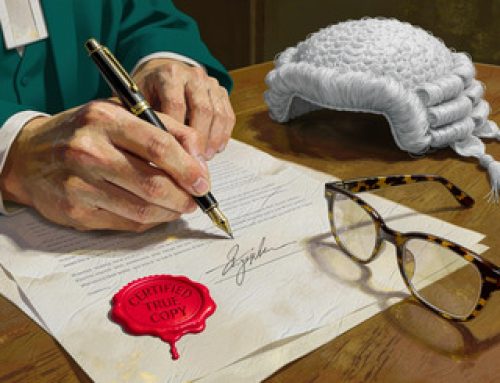
  • If it’s a private document or a copy of the original, get it certified

  • Submit the document to the Foreign, Commonwealth, and Development Office (FCDO) Legalisation Office directly or through an FCDO-registered agent

  • Pay the standard FCDO fee

  • Receive the apostilled document via courier. If you used a registered agent, they may collect it in person from the FCDO Legalisation Office business counter

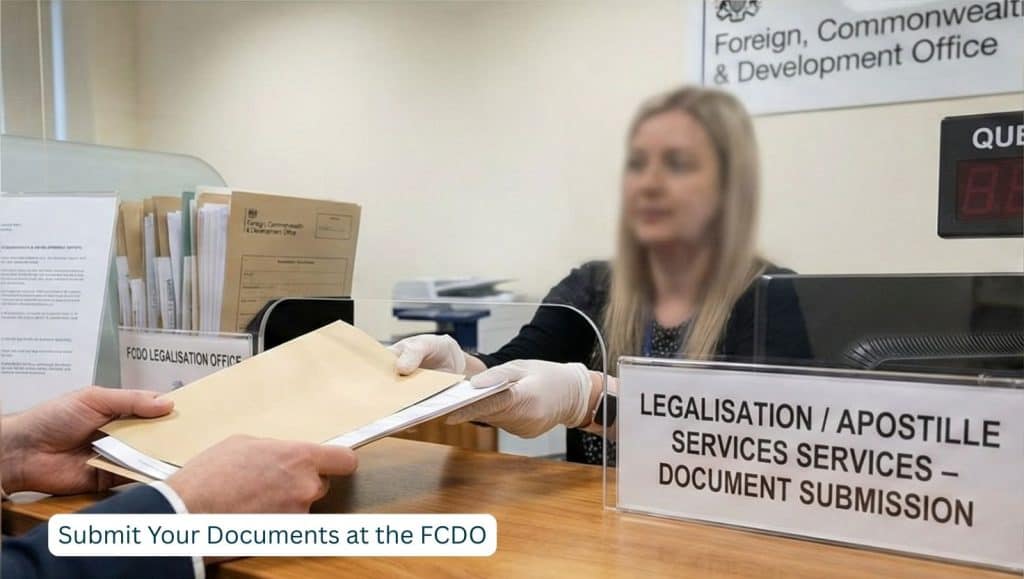
Person submitting documents at the FCDO Legalisation Office counter for apostille processing

Which documents can be apostilled?

Most personal, educational, business, and legal documents can be apostilled. For example, foreign authorities often request apostilles for the following documents:

  • Personal documents: Birth, marriage, death, and ACRO police certificates.

  • Educational documents: Transcripts, diplomas, and degree certificates.

  • Business documents: Certificates of incorporation, articles of association, and powers of attorney.

  • Legal documents: Court orders, decree absolute, and grant of probate.

Additionally, the FCDO can only apostille documents originating from the UK. If you have a foreign document, you can get it apostilled in its country of origin – or check with a UK notary or apostille agency if your foreign document can be processed in the UK.

How to check if your document is apostille-ready

Ensuring your document is apostille-ready before submitting it to the FCDO is essential to avoid rejections and delays.

Here are some of the requirements to keep in mind:

  • The wet-ink requirement: For notarial acts, such as powers of attorney, statutory declarations, affidavits, and notarised translations, the FCDO requires you to submit the original, wet-ink-signed document.

  • The GRO requirement: When submitting a public document issued by the General Register Office (GRO), such as a birth or marriage certificate, the document must be the original (no photocopies).

  • Private documents: Private documents, such as educational certificates and business documents, must be certified by an FCDO-registered solicitor or notary before the FCDO can apostille them. The certification confirms that the signature on the document is genuine and/or that the document is a true copy of the original.

Further, ensure the document is in good condition. The FCDO will reject it if it is laminated, faded, or damaged.

Person checking official documents to ensure they are apostille-ready

How to get an apostille in the UK step by step

The FCDO has standardised the process of acquiring apostilles in the UK. Here’s how to go about it step by step if you choose the DIY route.

  • Prepare your document: Ensure your document is apostille-ready. If it requires prior certification, have it certified by an FCDO-registered solicitor or a notary public.

  • Apply online: Go to the official government website and apply for either a paper-based apostille or an e-apostille.

  • Pay the fee: Pay the standard £45 fee for a paper-based apostille or £35 for an e-apostille using a debit or credit card.

  • Post your document: Use tracked mail to send the document to the FCDO Legalisation Office in Milton Keynes.

  • Receive your apostilled document: The FCDO will return the documents to you. It costs between £5.50 and £29.50 (per 1.5 kg) to courier the documents back to you, depending on where you are in the world.

The standard processing time for paper-based apostilles under the DIY route is typically over three weeks.

Choosing the right certifier for your apostille

You can use either an FCDO-registered solicitor or a notary public to certify a document before submitting it to the FCDO for an apostille.

  • A solicitor: Is a legal professional who helps clients with specialist areas of law. A solicitor’s certification is sufficient in most situations where you need to certify a “true copy” of a document, e.g., a photocopy of your degree certificate.

  • A notary public: Commonly referred to as “notaries”, notary publics are legal professionals who authenticate documents for international use. A notary’s certification is ideal for high-stakes transactions (such as share transfers) and when the requesting authority specifically requests notarisation.

For either route, you must ensure the professional details their full name, professional status (solicitor/notary public), and address. They must also date the certification and sign it in wet ink.

To avoid delays in getting your apostille, it is best to use an FCDO-registered solicitor or notary. You can find such a certifier by plugging into our professional network at London Apostille Services Ltd.

DIY apostille vs. full-service support

While you can apply for an apostille directly through the government website, it’s best to let an apostille agent handle the process on your behalf.

Specifically, the FCDO has registered business users (apostille agents/facilitators) who can drop off and pick up documents in person.

London Apostille Services Ltd. is one such registered user, and we offer an all-inclusive service that includes facilitating document certification on your behalf. We have vetted London solicitors and notaries in our network to facilitate this step.

Here’s how using our full-service support versus going the DIY route compares:

  • Speed: Our expedited apostille service can get your documents apostilled the next working day. The DIY route will likely take two weeks or more.

  • Coordination: We’ll facilitate document certification on your behalf. The DIY route means you’ll have to find a solicitor or notary on your own and negotiate/coordinate with them.

  • Document preparation: We’ll ensure your document is apostille-ready and meets the specific requirements of its destination. You may not have the experience to do this on your own, which could lead to rejections and delays.

Therefore, the full-service support option is significantly superior if you value speed and convenience.

Contact our team today to get your UK document apostilled quickly. We’ll provide expert guidance to ensure it is fully legalised for its specific destination.

Frequently asked questions (FAQs)

Here are answers to some common questions about how to apostille a document in the UK.

The FCDO fee is £45 for a paper-based apostille and £35 for an e-apostille. You must also account for certification costs, as well as agency fees if you hire an FCDO-registered agent.

For instance, our all-inclusive fees at London Apostille Services Ltd. are as follows:

  • Next-Day Apostille Service (1 Working Day):
    • No certification: £97 per document.
    • With solicitor certification: £135 per document.
    • With notarisation and apostille: £220 per document.
  • Standard Apostille Service (3 to 4 Working Days):
    • No certification: £87 per document.
    • With solicitor certification: £120 per document.
    • With notarisation and apostille: £210 per document.

Working with an FCDO-registered agent, you can get an apostille the next working day. The DIY route will likely take 15 working days or more.

Yes, especially if it is an e-apostille. For standard paper-based apostilles, you can courier your documents to our office, and we’ll manage the apostille process on your behalf. We’ll send the fully-legalised document back to you via DHL.

Yes, you can apostille multiple documents in a single application. Each document will get its own apostille certificate.

Also, where applicable, you can apostille a set of documents with one apostille on the cover sheet. It applies when you are dealing with bundled documents, e.g., company accounts.

Apostilles are accepted in countries that are parties to the Hague Apostille Convention. For countries that are not party to the convention, you’ll likely need embassy attestation in addition to the FCDO-issued apostille.

Get your apostille the right way

Getting any step in the apostille process wrong can lead to rejections, causing costly delays. It can be especially devastating when you have an urgent need for document legalisation.

Therefore, relying on full-service agency support is the way to go.

At London Apostille Services Ltd., we’ll ensure your documents are legalised correctly the first time. We offer:

  • Correct document preparation and certification

  • Secure handling of your original documents

  • An expedited apostille process to ensure your documents are apostilled in one working day under our Express Service or within three to four days under our Standard Service

  • Transparent all-inclusive pricing

Contact us today to take the guesswork out of the apostille process and get your documents legalised correctly on the first application.